Showing posts with label Thrillers. Show all posts

Friday, 1 September 2017

Thinking Up Novels in the Bath

Mozart got his ideas while playing billiards, Lawrence Sterne while shaving.Luis Buñuel liked to sit on his own in a quiet bar sipping a dry martini. I seem to get mine in the bath. This is probably related to the fact that baths invariably send me to sleep, which is why I prefer showers on working days. On mornings when I have nothing pressing to do, I get in the bath, fall asleep, come round as the water becomes lukewarm and, lying there in a state somewhere between sleeping and waking, usually come up with another idea for a novel.

I have published two novels, twenty-five years apart and very different from each other. WHOM (1989) is a satirical romp about a womanizing US President who may or may not bring about an apocalyptic nuclear war by interfering in the politics of a fictitious Mediterranean island. Like so many first novels, it's a mish-mash of influences: Thomas Pynchon, Mikhail Bulgakov and Evelyn Waugh are the main ones I detect in it now. I still think it's quite funny - there's an extract from it here. The Book of the Needle (2014) is a more mature piece of work, a historical novel based on the story of the real-life 17th-century Welsh prophet and tailor Arise Evans; I researched it thoroughly and learned a lot about both history and fiction from the process, though I hoped, as with the earlier novel, to write something people would find funny and entertaining. Both novels could reasonably be said to have sunk without trace, and the process of writing a novel (two years for the first, four and a half for the second) is something I've found deeply disillusioning.

Yet I still dream of writing a novel. I read fiction constantly (whereas my poetry reading tends to be in bursts), and my love of narrative finds an outlet in many of my poems and poetic sequences. I have the poet's weakness of obsessing over phrases and details, and I find plots very difficult, which is why much of my recent work, in both poetry and fiction, has involved retelling existing stories. Otherwise, I think I have the makings of a novelist: I can write good prose and dialogue, invent characters, handle complex structures, and so on. The difficulty, as always, is to commit oneself to such a big project with no guarantee of finding a readership, or even a publisher, at the end of it. And the market has changed so much, and become so relentlessly commercial, over the past few years, that it seems harder than ever, especially for someone whose inclinations are towards the unfashionable modes of literary and (mildly) experimental fiction.

So I dream in the bath of a novel that I would enjoy enough to stick at it through all the uncertainties of the writing process, and might be able to sell at the end. Some of these ideas are old friends, which have surfaced many times before, only to be rejected for some difficulty or other, or because another one has come along which temporarily seems more exciting. Some are even things I have written already in a different genre, but which might be worth expanding into novel form. Some are obviously absurd, and yet, maybe with a little twist...

Here are some of them:

   An adaptation of my poetic sequence Mandeville, about the medieval traveller Sir John Mandeville.

   The autobiographical novel Starling City, about a breakdown I had in my early mid-twenties when I was living in 1980s Brighton. Perhaps combined with an old idea about a detective mystery in which the detective is a post-modernist who doesn't believe in truth.

   A historical novel about the early modern scientist Robert Hooke, about whom I have already written some poems.

   A novel based on the life of the food writer Elizabeth David, which I would fictionalize, combining her story with that of several other women of the time who had similarly adventurous lives.

   A historical thriller in which the protagonist is Christopher Marlowe, who narrates it in a voice borrowed from his namesake Philip Marlowe.

   A fantasy set in the world of pastoral in which everyone is either a shepherd or shepherdess, or pretends to be.

   A novel about the building of the great Welsh reservoirs.

   A novel based loosely on the life of W.S. Graham.

   A novel about a seventeenth-century astrologer and the cases he investigates.

   A ghost story with M.R.James as its protagonist.

   A alternative history novel in which the chess match between Fischer and Karpov, which was scheduled for 1975 but never took place, actually happens, in Cambridge where I was living at the time.

I think several of these ideas are plausible. But every time I contemplate putting in the work I remember my agent asking, of The Book of the Needle: "How are you going to sell this book?" And,not being able to think of an answer, I go back to writing poems, which I do at least have a publisher for.

Wednesday, 1 February 2012

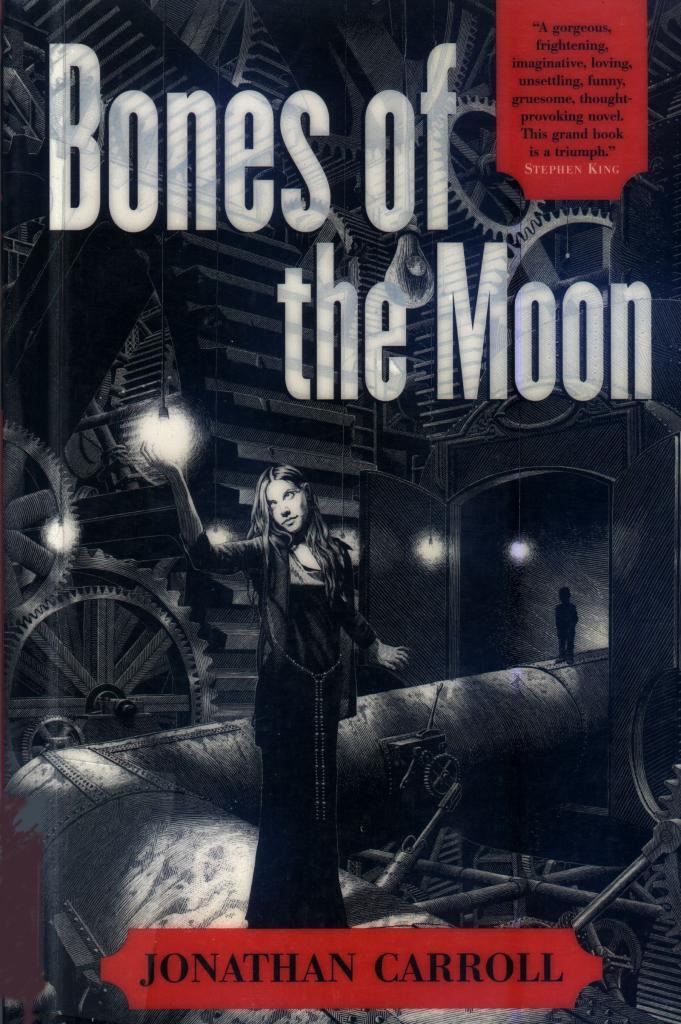
Jonathan Carroll: Bones of the Moon

Bones of the MoonLike most writers, I've woken up many times in the grip of a dream that seems like perfect material for a novel or a poem. Maybe you get as far as jotting it down before going back to sleep. When you wake up again, there's nothing there that makes sense. Dreams are fascinating to live through, but nonsense in daylight. Or, worse, they make too much sense - it's embarrassingly obvious what waking thoughts and experiences got translated into them. Either way they don't generally make good literature. And yet the urge to use them remains. Dreams are narratives, after all, and their very strangeness gives them the element of surprise we value in fiction. For writers who are fascinated by their own art (and what writer isn't?) they make a great metaphor for writing itself. They are used as a conventional framing device in,for example, Piers Plowman, The Divine Comedy, Alice. When we read them in this form, we're well aware of the conventions; the dream is not a real dream, and only retains those dreamlike characteristics that fit the writer's purpose.

In The Arabian Nightmare, Robert Irwin concentrates on two characteristics of dreams, the difficulty the sleeper sometimes has in telling sleep from waking, and the nesting of dreams within dreams. There is also a dreamlike strangeness due to the magical element that appears from time to time - but because of the blurring of sleep and waking, we never know if it's real or dream magic. Irwin's dreams are conventional - we are well aware that they are just another mode of storytelling. But there is one novel I know where the dreams are both an effective part of the narrative, and genuinely dreamlike.

Cullen James is a happily married woman living in New York with her husband and baby daughter. But there are a few shadows in her life. In the apartment downstairs, as we learn in the opening sentence of Bones of the Moon, a boy has gone crazy and killed his mother and sister with an axe. Before her marriage, Cullen herself had a series of unhappy relationships, culminating in an abortion about which she still has feelings of guilt. A charismatic but frightening film director is making insistent passes at her. And Cullen is suffering from her own version of the Arabian Nightmare, a series of intensely vivid dreams which connect together to form a continuous narrative:
How strange it was to eat glass and light. All of the food on the table was laid out beautifully and precisely. The spread would have looked delicious if everything wasn't transparent; splashing the light from the icy chandelier hung high and huge over the crystalline dining-table.
     Pepsi picked up his clear hot-dog wrapped in its clear bun and took a big bite. His walking stick leaned against the chair and was the only patch of colour around. Exposed to the sun for days on our walk here, the sticks had burned or ripened... changed from their original grey-brown to a deep, vivid purple.
     Sizzling Thumb had mine over his lap and kept petting it like a cat. 'Your tapes arrived without chicken.'
The dreams take the form of a quest through a magical land called Rondua. Cullen's companions are a number of talking animals, notably a hat-wearing dog called Mr Tracy, and a small boy, Pepsi, who is her son in the dreamworld (and, as we soon realize, a projection of her guilt about the abortion). They are searching for five magic tokens called the Bones of the Moon. And for all their surreal quality the dreams have a consistent structure: as they travel through the different regions of Rondua and collect the bones, the dream story moves towards its climax, a confrontation with the villainous Jack Chili. Meanwhile, Cullen's waking life is becoming more disturbed. The 'axe-boy', now in prison, has begun a worryingly obsessive correspondence with her. She seems to be developing supernatural powers; and the film director, Weber Gregston, starts having the same dreams.

Bones of the Moon is a brilliantly constructed fantasy thriller, though it teeters on the edge of sentimentality at times. But what really sets it apart is the portrayal of the dreams. Stephen King, an admirer of the book, has written: 'When has any novelist last caught so perfectly the weird but matter-of-fact experience of dreaming?' Never,as far as I know. These are the most dreamlike dreams I have ever seen in fiction, as absurd as they are compelling.

It's a nice piece of synchronicity that the author shares his surname with the author of the Alice books (though Lewis Carroll,of course,is a pen-name, while Jonathan is a Carroll by birth). He has written some fifteen novels, and all of those I've read show the same dazzling originality and imagination that characterize Bones of the Moon. Neil Gaiman, as well as King, is a fan. Carroll's first two novels, by the way, are published in the Fantasy Masterworks series, which I've mentioned before: I intend to blog about one of them at a later date.

Next time I'll be writing about an early, lesser-known novel by a major British post-war novelist.

Monday, 30 January 2012

Patrick Hamilton: Hangover Square

Hangover Square
Depersonalization is a psychological symptom in which the sufferer's sense of self is affected. The world suddenly feels remote and unreal. According to Wikipedia, it is the third most common psychological symptom, after anxiety and feelings of depression; it can be an indication of many underlying conditions, or induced by drugs, sleeplessness, shock, or even voluntarily, for example by meditation. If involuntary, it can be an unpleasant, alarming experience: I have suffered from it myself. So, undoubtedly, had Patrick Hamilton, who in his novel Hangover Square, gives a series of brilliant descriptions of it:
Like a camera. but instead of an exposure having been made the opposite had happened - an inclosure - a shutting down, a locking in. A moment before his head, his brain, were out in the world, seeing, hearing, sensing objects directly; now they were enclosed behind glass (like Crown jewels, like Victorian wax fruit), behind a film - the film of the camera, perhaps, to continue the photographic analogy - a film behind which all things and people moved eerily, without colour, vivacity or meaning, grimly, puppet-like, without motive or conscious volition of their own...
George Harvey Bone is a big, clumsy, unprepossessing man, living on a small inheritance in Earl's Court. His life revolves around two obsessions, the unpleasant Netta, whom he loves and despises at the same time, and the drink which is his only consolation for her rejection of him, as well as the main interest the two have in common. Netta is at the centre of a small group of hard-drinking, idle friends who exploit Bone for his comparative prosperity while mocking him to his face. It is just after the Munich agreement; Netta and the friends are supporters of Chamberlain, admirers of Hitler and Mussolini, another reason Bone has for hating them. But they continue their round of the London pubs, with a couple of trips to Brighton thrown in, endlessly engaged in the kind of mean-minded drunken smalltalk which is Hamilton's great contribution to fictional dialogue. From time to time Netta has a fling with someone, never with Bone. And from time to time also, he has what he calls one of his dead moods, his attacks of depersonalization. At such moments, he feels an overwhelming compulsion to kill Netta, a certainty that he will in fact eventually kill her. Then the mood passes and he cannot remember anything about it.

Hangover Square is the darkest of Hamilton's novels. Unlike his other masterpieces Twenty Thousand Streets Under the Sky and The Slaves of Solitude, both of which I hope to blog about in the future, it has very little humour. But, for me, it's his greatest achievement, an unblinking examination of the alcoholic bohemian lifestyle he knew so well, and which eventually killed him. One reason for that is the use of depersonalization: has any other writer described this symptom so well? And yet I strongly suspect it's a common experience of writers, of creative people generally. To write really effectively, you have to be able to drain the emotion from a scene, to look at it as if you weren't really feeling it. That way it becomes strange and new. The term used in literary criticism is defamiliarization - but that's only the literary manifestation of depersonalization. Hamilton gives us a defamiliarized Earl's Court through the eyes of a depersonalized George Harvey Bone. He takes the emotion out so that it will be all the more effective when it rushes back in again:
It almost knocked him down. It made him reel. It was as though he had been hit by something. And yet he knew what it was. It was only his head, cracking back. And with the crack everything came flooding, rushing, roaring back - noise, colour, light, the fury of the real, everyday world.
Hamilton was a successful writer in his lifetime; his plays Gaslight and Rope were both made into films, and made him a wealthy man. But after his death, in 1962 at the age of 58, his reputation went into eclipse. Since then there have been sporadic attempts to revive it, and the current one seems, finally, to have taken off. Twenty Thousand Streets Under the Sky was dramatized on BBC Television a few years ago, and his major works are all in print, including the Gorse trilogy, which I haven't read, and which is less highly regarded than the other novels I've mentioned. I hope he is now back for good where he belongs, among the major British novelists of his era.

Next time, a surreal story about dreaming by a unique US fantasy novelist.

Friday, 27 January 2012

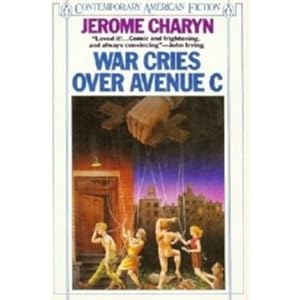
Jerome Charyn: War Cries Over Avenue C


Sometimes I think I started this blog for Jerome Charyn. Or at any rate that he is the author who most perfectly sums up what the blog is about. I still remember the first book of his I came across - it was in one of those bargain second-hand boxes, three for 50p. I had found two I wanted and was looking for a third, and there was Marilyn the Wild. I picked it because it was short, in good condition, and was published by Bloomsbury, who had just published my novel WHOM. I loved it. My editor at Bloomsbury was a fan, too - every time he moved to a new publisher, he signed Charyn up; but, he added, he just doesn't sell.

Marilyn the Wild is part of a series Charyn has written about a New York Jewish cop called Isaac Sidel. I'll write about these in a later posting, but for now I'm going to consider one of his stand-alone novels. War Cries Over Avenue C is set in New York's Alphabet City, an area which is introduced to us in a spoof prologue supposedly written by 'Doris Quinn, Your Manhattan Spy':
Cars move slower on Avenue A. You could die whistling and might not meet a Checker cab. You've entered Indian country without even knowing it.
The combination of urban realism and disconcerting playfulness is characteristic. He knows the world he's writing about so well that it's hard tell when he's exaggerating, or just plain making things up. Sarah Fishman, Saigon Sarah from her time as a nurse in Vietnam, when she wore two .45s to defend her Viet Cong patients from their interrogators, now lives in a fortified Talmud school on Avenue C with her childhood sweetheart, Howie Biedersbill, a Henry-James-loving assassin who still has bits of shrapnel in his scalp from his own Vietnam years. They manage to survive in a world of CIA agents, Bolivian drug-runners and KGB men who use Mont Blanc fountain pens as a weapon. Howie's arch-enemy Capablanca holds him upside down out of a window to force him to admit that Gabriel Garcia Marquez (El Nobel) is a greater writer than Henry James. The Vietnam that provides the backstory to this saga of a crazed New York is just as surreal: Howie has lived among the Montagnards of the Central Highlands in a tribe of sorcerers and magicians:
They took their hammocks, their chicken claws, their poison tubs, tobacco, salt pots, arrows, antidotes, jewels and silver pipes, opium balls they'd fashioned from their last Cambodian brick and ate like cotton candy, a mound of plastique that Judith kept in a rag, jungle knives, French cigarettes that the matriarchs liked to smoke when their mouths grew sore from silver pipes, cutlery to prepare food for the devils, children's toys, French panties from Saigon for the teenage girls, a medicine chest of roots, barks and herbs, white cotton leggings that the women sometimes wore, a clutch of high-heeled shoes, the spirit table and the spirit chair.
[Judith, by the way, is a man who uses a woman's name for magical reasons.]

A touch of El Nobel in that passage, perhaps? Such a long sentence is rare in Charyn's work - he usually writes in the tersest of hard-boiled prose. But even in the most thriller-like passages of War Cries, there is still the sense, as there is in the work of that other New York Jew William Tenn, of the magic that automatically occurs when tribes who are totally alien to each other are suddenly thrust into proximity. Tenn's Venusians are no stranger than Charyn's Montagnards.

Charyn spent many years teaching in Paris, and still has a home there. Honoured with the rank of Commandeur des Arts et des Lettres, he is not the first American writer to be more appreciated in France than his native land. (There is another example on my list of subjects for future blog entries.) The author of thirty novels, he is still writing at 74, and his most recent publication, The Secret Life of Emily Dickinson, sounds like one of his most daring projects. Other books chronicle his interests in film, table tennis, baseball, the Wild West, and, of course, the history of New York. And, as with William Tenn, Robert Irwin, H.F.M Prescott and so many other authors I intend to cover on White Threshold, hardly anyone I know seems to have heard of him.

Next time, a major British mid-20th-century novelist who seems at long last to be on the verge of achieving the reputation he deserves.

Monday, 23 January 2012

Shirley Jackson: We Have Always Lived in the Castle

We Have Always Lived in the Castle
Merricat, said Connie, would you like a cup of tea?
Oh no,said Merricat, you'll poison me.
Merricat, said Connie, would you like to go to sleep?
Down in the boneyard ten feet deep!
In Riddley Walker, Russell Hoban makes powerful use of children's rhymes to create atmosphere. In We Have Always Lived in the Castle, there's only one rhyme, but it re-echoes throughout, epitomizing the novel's darkly naive tone. Merricat is Mary Katherine Blackwood, the eighteen-year-old narrator, and Connie is her beloved elder sister Constance. The Castle is the grand house they live in with their disabled Uncle Julian; because we see them through Merricat's eyes, and she is clearly quite disturbed, we never really see the Castle and its adjacent village as part of modern America - they are always on the verge of becoming a fantasy realm. Six years ago the rest of the Blackwood family were murdered. Constance was accused of the crime but acquitted for lack of evidence. The villagers, whose children taunt Merricat with the rhyme above, still hate and fear both of them. This is the situation when a cousin, Charles, comes to visit, upsetting the balance of this strange household.

The Gothic has been an important strain in American literature since well before its two great nineteenth-century exponents Poe and Hawthorne. But those two writers stand for the two main currents in American Gothic, the Southern and New England varieties. After all, the Gothic depends on a strong sense of the past, and the South and New England are the oldest parts of the United States, the areas where the image of a castle or a grand old house haunted by ancestral ghosts seems least incongruous. Also both have strong religious traditions and the sense of evil that goes with them. And Gothic without a sense of evil is just a kind of literary fancy dress.

Shirley Jackson was born in California, but lived in Vermont. In her six novels you can see her working her way into the New England Gothic tradition, creating more and more convincingly a world that is both magical and contemporary. And she has the sharpest eye for evil of any writer I can think of. For Jackson, it doesn't come as buckets of blood and torture porn and it never comes unmixed; there are no monsters in her work. There is evil in the Castle, but there is also charm, humour and a particularly touching portrayal of sisterly love. And there is evil outside the Castle, too, in the villagers' hatred - understandable in its origin but always ready to go out of control.

Much of the fascination of the book is in Merricat's voice, childlike in spite of her age. Jackson is superb on children, and wrote a couple of books about her own experiences as a mother: one of them is called life Among the Savages, and as this title implies, her theme, for all the love and humour with which she writes, is that they are as prone to evil as the rest of us - indeed, it's more obvious in children because they haven't learned to hide it. The children persecute Merricat with their rhymes and her own vindictiveness towards Charles is inseparable from her childish preoccupation with the comfortable rituals of her life.

Castle is a short novel, almost a novella, and utterly gripping. The major twist in the plot is one that almost every reader will have seen coming long before, but there is another, almost incidental, surprise which is quite devastating. It's the work of a brilliant writer at the height of her powers: sadly,she died soon after completing it, at the age of 49, worn out by psychological problems and abuse of prescription drugs. Her vision cannot have been a comfortable one to live with, and it says a lot for her both as a person and an artist that her work, though always disturbing, is never depressing. (Much of it is extremely funny.) She is better known in the US than the UK - I'd never heard of her till a reader recommended her on one of the Guardian Books blogs. Even there, her reputation seems to rest mostly on one short story, 'The Lottery', and on her novel The Haunting of Hill House, which was made into a successful film. There have been rumours of a forthcoming film of Castle for a long time now, but I haven't heard of a release date yet. I'll return to Jackson in the future, as I will to several of the other authors I cover in this blog.

Next time, a quirky thriller by an imaginative and immensely prolific US novelist who excels across several genres.