Showing posts with label Magic Realism. Show all posts

Friday, 27 January 2012

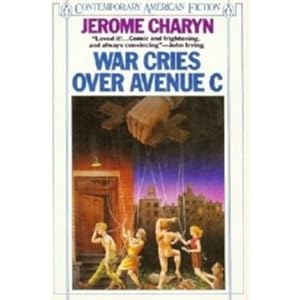
Jerome Charyn: War Cries Over Avenue C


Sometimes I think I started this blog for Jerome Charyn. Or at any rate that he is the author who most perfectly sums up what the blog is about. I still remember the first book of his I came across - it was in one of those bargain second-hand boxes, three for 50p. I had found two I wanted and was looking for a third, and there was Marilyn the Wild. I picked it because it was short, in good condition, and was published by Bloomsbury, who had just published my novel WHOM. I loved it. My editor at Bloomsbury was a fan, too - every time he moved to a new publisher, he signed Charyn up; but, he added, he just doesn't sell.

Marilyn the Wild is part of a series Charyn has written about a New York Jewish cop called Isaac Sidel. I'll write about these in a later posting, but for now I'm going to consider one of his stand-alone novels. War Cries Over Avenue C is set in New York's Alphabet City, an area which is introduced to us in a spoof prologue supposedly written by 'Doris Quinn, Your Manhattan Spy':
Cars move slower on Avenue A. You could die whistling and might not meet a Checker cab. You've entered Indian country without even knowing it.
The combination of urban realism and disconcerting playfulness is characteristic. He knows the world he's writing about so well that it's hard tell when he's exaggerating, or just plain making things up. Sarah Fishman, Saigon Sarah from her time as a nurse in Vietnam, when she wore two .45s to defend her Viet Cong patients from their interrogators, now lives in a fortified Talmud school on Avenue C with her childhood sweetheart, Howie Biedersbill, a Henry-James-loving assassin who still has bits of shrapnel in his scalp from his own Vietnam years. They manage to survive in a world of CIA agents, Bolivian drug-runners and KGB men who use Mont Blanc fountain pens as a weapon. Howie's arch-enemy Capablanca holds him upside down out of a window to force him to admit that Gabriel Garcia Marquez (El Nobel) is a greater writer than Henry James. The Vietnam that provides the backstory to this saga of a crazed New York is just as surreal: Howie has lived among the Montagnards of the Central Highlands in a tribe of sorcerers and magicians:
They took their hammocks, their chicken claws, their poison tubs, tobacco, salt pots, arrows, antidotes, jewels and silver pipes, opium balls they'd fashioned from their last Cambodian brick and ate like cotton candy, a mound of plastique that Judith kept in a rag, jungle knives, French cigarettes that the matriarchs liked to smoke when their mouths grew sore from silver pipes, cutlery to prepare food for the devils, children's toys, French panties from Saigon for the teenage girls, a medicine chest of roots, barks and herbs, white cotton leggings that the women sometimes wore, a clutch of high-heeled shoes, the spirit table and the spirit chair.
[Judith, by the way, is a man who uses a woman's name for magical reasons.]

A touch of El Nobel in that passage, perhaps? Such a long sentence is rare in Charyn's work - he usually writes in the tersest of hard-boiled prose. But even in the most thriller-like passages of War Cries, there is still the sense, as there is in the work of that other New York Jew William Tenn, of the magic that automatically occurs when tribes who are totally alien to each other are suddenly thrust into proximity. Tenn's Venusians are no stranger than Charyn's Montagnards.

Charyn spent many years teaching in Paris, and still has a home there. Honoured with the rank of Commandeur des Arts et des Lettres, he is not the first American writer to be more appreciated in France than his native land. (There is another example on my list of subjects for future blog entries.) The author of thirty novels, he is still writing at 74, and his most recent publication, The Secret Life of Emily Dickinson, sounds like one of his most daring projects. Other books chronicle his interests in film, table tennis, baseball, the Wild West, and, of course, the history of New York. And, as with William Tenn, Robert Irwin, H.F.M Prescott and so many other authors I intend to cover on White Threshold, hardly anyone I know seems to have heard of him.

Next time, a major British mid-20th-century novelist who seems at long last to be on the verge of achieving the reputation he deserves.

Wednesday, 18 January 2012

Robert Irwin: The Arabian Nightmare

The Encyclopedia of FantasyOne of my most fruitful sources of cult fiction is The Encyclopedia of Fantasy, edited by John Clute and John Grant. It's much more than a reference work; you can spend hours browsing among its articled under such imaginative headings as Fimbulwinter (the Norse myth of an unending winter has many modern offshoots, including the opening scenes of The Lion the Witch and the Wardrobe), or Into the Woods (Stephen Sondheim's musical is one example among many of the trope of a forest where normal human order is replaced by something more chaotic). I imagine I found The Arabian Nightmare under Dreams, since this is the novel's major theme.

Robert Irwin is a distinguished scholar of medieval Arabic literature, whose works include The Arabian Nights: A Companion. The Arabian Nights is what The Encyclopedia of Fantasy calls a Taproot Text, a classic work that continues to influence later generations of writers. In particular, postmodern novelists like John Barth have found inspiration in the way some of the stories are nested inside each other, many levels deep. The Arabian Nightmare is Irwin's treatment of this idea.

A group of pilgrims enters medieval Cairo, and puts up at a caravanserai, where one of them, a young Englishman called Balian, falls asleep and has a disturbing dream. When he wakes, blood is pouring from his mouth and nose, and the other pilgrims are crowding round in concern. He seems to have an illness - well, at least, they keep reassuring him, it is not the Arabian Nightmare. In the Arabian Nightmare, the dreamer experiences infinite suffering at night, and then wakes up in the morning unable to remember any of it. It is the ultimate in pointless suffering, so much so that some believe the Messiah himself will be one who has been purified by this disease.

The Cairo Balian encounters is a city of squalor and magic. Huge mountains of refuse outside the city walls cause dust and foul air to blow down the hot streets. There are great encampments of beggars sleeping in the open air, dwarfs, mountebanks and storytellers entertaining the citizens. There is a tightrope-walker who performs in his sleep (funambulist and somnambulist at the same time). The streets are haunted by Fatima the Deathly, an irresistibly attractive woman who lures men to their doom, and by rumours of the Laughing Dervishes, whose outrageous hilarity can disrupt the most solemn rituals. Everyone seems to be involved in a conspiracy, either for the Sultan or against him.

But how much of this is real, and how much a dream? Balian keeps waking up in his own blood, unsure at what point he fell asleep. He is having an affair with the seductive Zuleyka, who teaches him the art of giving sexual pleasure to a woman (as a medieval Western Christian, Balian has trouble at first understanding why he should want to). He undergoes treatment from the Father of Cats, a physician who specializes in the diseases of sleep, and is chased through the labyrinthine streets by a secret society of leper knights. Perhaps he has the Arabian Nightmare after all.

This appears to be Balian's story, but there are whole chapters where he doesn't feature. Sometimes we read instead about the Father of Cats, the Dawadar or Bearer of the Royal Inkwell, the English graverobber Michael Vane. There is a narrator, the Coptic storyteller Dirty Yoll, who seems to be controlling things - but is he a character in Balian's dreams, or is Balian a character in Yoll's story? At a certain point it becomes impossible to tell. And just when we are feeling totally lost, Yoll breaks off the main narrative to tell us another set of stories altogether, an Arabian Nights in miniature. There are four chapters of this Interlude, as Yoll calls it:
An Interlude - The Tale of the Talking Ape
The Interlude Concluded
The Interlude Concluded Continued
The Conclusion of the Continuation of the Interlude's Conclusion
It's my favourite part of the book. Stories spawn stories at a startling rate, each one echoing and parodying the others. There is a boy who was brought up by wolves, another who was brought up by apes, by bears, by leopards. There is a voyage to the end of the world. There are murders, enchantments, riddles, seductions. And there is just a page or so on the theme of three wishes in which Irwin plays every possible variation you can imagine on this ancient idea.

The Arabian Nightmare is not a novel for those who can't stand conspicuous cleverness. You can tell it's by an academic, and also, perhaps, that it's a first novel. It begins, anachronistically, with a quote from Proust and there are numerous other literary references scattered throughout. But to me its ingenuity and creativity are irresistible, and it offers a beguiling picture of the medieval Arab culture Irwin knows so well - though it's probably best to confirm some of the details from his more scholarly writings. He is now a full-time writer and has written several other well-received novels. The Arabian Nightmare's reputation has grown slowly; it is still in print some thirty years after its first publication, and has established itself as a cult classic.

Next time I'll be writing about the blackest of black comedies by an arch-exponent of the American Gothic.