Showing posts with label New York. Show all posts

Wednesday, 1 February 2012

Jonathan Carroll: Bones of the Moon

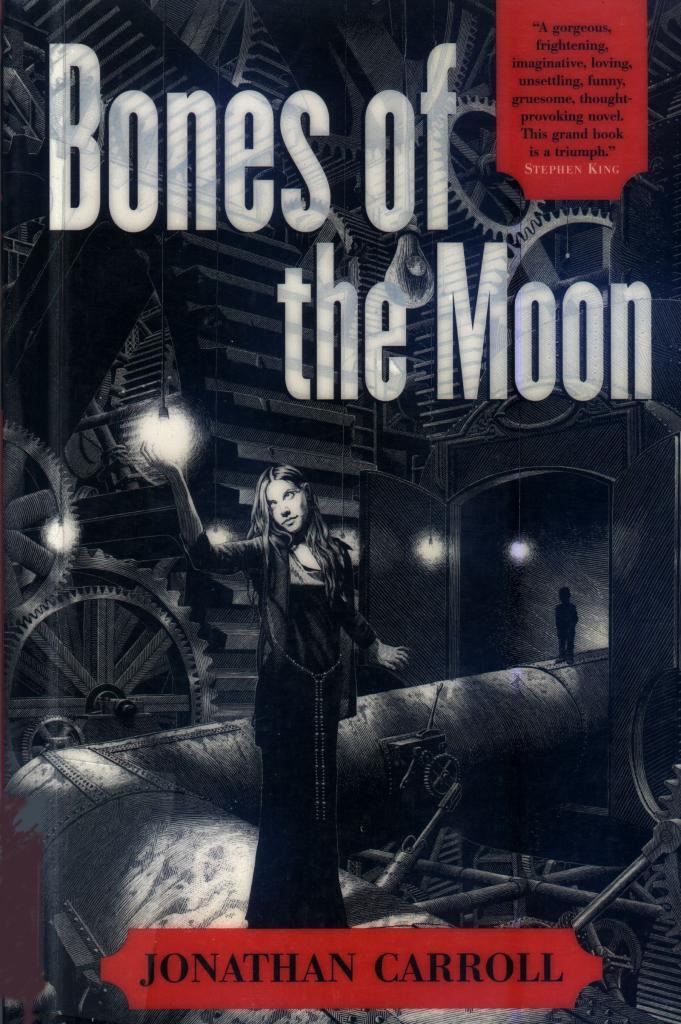
Bones of the MoonLike most writers, I've woken up many times in the grip of a dream that seems like perfect material for a novel or a poem. Maybe you get as far as jotting it down before going back to sleep. When you wake up again, there's nothing there that makes sense. Dreams are fascinating to live through, but nonsense in daylight. Or, worse, they make too much sense - it's embarrassingly obvious what waking thoughts and experiences got translated into them. Either way they don't generally make good literature. And yet the urge to use them remains. Dreams are narratives, after all, and their very strangeness gives them the element of surprise we value in fiction. For writers who are fascinated by their own art (and what writer isn't?) they make a great metaphor for writing itself. They are used as a conventional framing device in,for example, Piers Plowman, The Divine Comedy, Alice. When we read them in this form, we're well aware of the conventions; the dream is not a real dream, and only retains those dreamlike characteristics that fit the writer's purpose.

In The Arabian Nightmare, Robert Irwin concentrates on two characteristics of dreams, the difficulty the sleeper sometimes has in telling sleep from waking, and the nesting of dreams within dreams. There is also a dreamlike strangeness due to the magical element that appears from time to time - but because of the blurring of sleep and waking, we never know if it's real or dream magic. Irwin's dreams are conventional - we are well aware that they are just another mode of storytelling. But there is one novel I know where the dreams are both an effective part of the narrative, and genuinely dreamlike.

Cullen James is a happily married woman living in New York with her husband and baby daughter. But there are a few shadows in her life. In the apartment downstairs, as we learn in the opening sentence of Bones of the Moon, a boy has gone crazy and killed his mother and sister with an axe. Before her marriage, Cullen herself had a series of unhappy relationships, culminating in an abortion about which she still has feelings of guilt. A charismatic but frightening film director is making insistent passes at her. And Cullen is suffering from her own version of the Arabian Nightmare, a series of intensely vivid dreams which connect together to form a continuous narrative:
How strange it was to eat glass and light. All of the food on the table was laid out beautifully and precisely. The spread would have looked delicious if everything wasn't transparent; splashing the light from the icy chandelier hung high and huge over the crystalline dining-table.
     Pepsi picked up his clear hot-dog wrapped in its clear bun and took a big bite. His walking stick leaned against the chair and was the only patch of colour around. Exposed to the sun for days on our walk here, the sticks had burned or ripened... changed from their original grey-brown to a deep, vivid purple.
     Sizzling Thumb had mine over his lap and kept petting it like a cat. 'Your tapes arrived without chicken.'
The dreams take the form of a quest through a magical land called Rondua. Cullen's companions are a number of talking animals, notably a hat-wearing dog called Mr Tracy, and a small boy, Pepsi, who is her son in the dreamworld (and, as we soon realize, a projection of her guilt about the abortion). They are searching for five magic tokens called the Bones of the Moon. And for all their surreal quality the dreams have a consistent structure: as they travel through the different regions of Rondua and collect the bones, the dream story moves towards its climax, a confrontation with the villainous Jack Chili. Meanwhile, Cullen's waking life is becoming more disturbed. The 'axe-boy', now in prison, has begun a worryingly obsessive correspondence with her. She seems to be developing supernatural powers; and the film director, Weber Gregston, starts having the same dreams.

Bones of the Moon is a brilliantly constructed fantasy thriller, though it teeters on the edge of sentimentality at times. But what really sets it apart is the portrayal of the dreams. Stephen King, an admirer of the book, has written: 'When has any novelist last caught so perfectly the weird but matter-of-fact experience of dreaming?' Never,as far as I know. These are the most dreamlike dreams I have ever seen in fiction, as absurd as they are compelling.

It's a nice piece of synchronicity that the author shares his surname with the author of the Alice books (though Lewis Carroll,of course,is a pen-name, while Jonathan is a Carroll by birth). He has written some fifteen novels, and all of those I've read show the same dazzling originality and imagination that characterize Bones of the Moon. Neil Gaiman, as well as King, is a fan. Carroll's first two novels, by the way, are published in the Fantasy Masterworks series, which I've mentioned before: I intend to blog about one of them at a later date.

Next time I'll be writing about an early, lesser-known novel by a major British post-war novelist.


Friday, 27 January 2012

Jerome Charyn: War Cries Over Avenue C


Sometimes I think I started this blog for Jerome Charyn. Or at any rate that he is the author who most perfectly sums up what the blog is about. I still remember the first book of his I came across - it was in one of those bargain second-hand boxes, three for 50p. I had found two I wanted and was looking for a third, and there was Marilyn the Wild. I picked it because it was short, in good condition, and was published by Bloomsbury, who had just published my novel WHOM. I loved it. My editor at Bloomsbury was a fan, too - every time he moved to a new publisher, he signed Charyn up; but, he added, he just doesn't sell.

Marilyn the Wild is part of a series Charyn has written about a New York Jewish cop called Isaac Sidel. I'll write about these in a later posting, but for now I'm going to consider one of his stand-alone novels. War Cries Over Avenue C is set in New York's Alphabet City, an area which is introduced to us in a spoof prologue supposedly written by 'Doris Quinn, Your Manhattan Spy':
Cars move slower on Avenue A. You could die whistling and might not meet a Checker cab. You've entered Indian country without even knowing it.
The combination of urban realism and disconcerting playfulness is characteristic. He knows the world he's writing about so well that it's hard tell when he's exaggerating, or just plain making things up. Sarah Fishman, Saigon Sarah from her time as a nurse in Vietnam, when she wore two .45s to defend her Viet Cong patients from their interrogators, now lives in a fortified Talmud school on Avenue C with her childhood sweetheart, Howie Biedersbill, a Henry-James-loving assassin who still has bits of shrapnel in his scalp from his own Vietnam years. They manage to survive in a world of CIA agents, Bolivian drug-runners and KGB men who use Mont Blanc fountain pens as a weapon. Howie's arch-enemy Capablanca holds him upside down out of a window to force him to admit that Gabriel Garcia Marquez (El Nobel) is a greater writer than Henry James. The Vietnam that provides the backstory to this saga of a crazed New York is just as surreal: Howie has lived among the Montagnards of the Central Highlands in a tribe of sorcerers and magicians:
They took their hammocks, their chicken claws, their poison tubs, tobacco, salt pots, arrows, antidotes, jewels and silver pipes, opium balls they'd fashioned from their last Cambodian brick and ate like cotton candy, a mound of plastique that Judith kept in a rag, jungle knives, French cigarettes that the matriarchs liked to smoke when their mouths grew sore from silver pipes, cutlery to prepare food for the devils, children's toys, French panties from Saigon for the teenage girls, a medicine chest of roots, barks and herbs, white cotton leggings that the women sometimes wore, a clutch of high-heeled shoes, the spirit table and the spirit chair.
[Judith, by the way, is a man who uses a woman's name for magical reasons.]

A touch of El Nobel in that passage, perhaps? Such a long sentence is rare in Charyn's work - he usually writes in the tersest of hard-boiled prose. But even in the most thriller-like passages of War Cries, there is still the sense, as there is in the work of that other New York Jew William Tenn, of the magic that automatically occurs when tribes who are totally alien to each other are suddenly thrust into proximity. Tenn's Venusians are no stranger than Charyn's Montagnards.

Charyn spent many years teaching in Paris, and still has a home there. Honoured with the rank of Commandeur des Arts et des Lettres, he is not the first American writer to be more appreciated in France than his native land. (There is another example on my list of subjects for future blog entries.) The author of thirty novels, he is still writing at 74, and his most recent publication, The Secret Life of Emily Dickinson, sounds like one of his most daring projects. Other books chronicle his interests in film, table tennis, baseball, the Wild West, and, of course, the history of New York. And, as with William Tenn, Robert Irwin, H.F.M Prescott and so many other authors I intend to cover on White Threshold, hardly anyone I know seems to have heard of him.

Next time, a major British mid-20th-century novelist who seems at long last to be on the verge of achieving the reputation he deserves.

Wednesday, 4 January 2012

William Tenn: Immodest Proposals / Here Comes Civilization

A smalltime businessman is sitting in his poky office when a man walks in without knocking and asks, "Would you be interested in buying a twenty for a five?" The newcomer is dirty and disreputable looking; the businessman tells him there are no beggars allowed in the building, and tries to throw him out. The newcomer wants to know what's wrong with his offer, but the businessman is unrelenting, so he retreats, leaving his card: he is Mr Ogo Eksar, operating out of a hotel in Times Square. The businessman, Bernie, can't get the incident out of his head. Obviously there's a catch, because no one in his right mind would offer to pay twenty dollars for a five-dollar bill. But Bernie's a bit of a hustler himself - he'd like to know what the catch is, and it can only cost him five dollars, at the worst, to find out. So he goes round to the hotel in Times Square, and they do the deal - the twenty and the five are exchanged and Eksar even insists on a receipt.

What happens now? Maybe Mr Eksar would be interested in another deal, say, buying a ten for a fifty, or a twenty for a hundred dollars?

Eksar is contemptuous. What kind of a deal is that?

Well, Bernie says, isn't there anything else you want to buy?

The Golden Gate Bridge.

This is the opening of William Tenn's short story 'Bernie the Faust'. In the course of a couple of pages, the two find themselves negotiating over other geographical features, like the Sea of Azov (It's only forty-nine feet deep! "Where are you going to do better than three hundred and eighty dollars for a sea like that?"), not to mention fishing and buried treasure rights on the moon. Bernie is slightly uneasy about the fact that he doesn't actually own any of these things, but Eksar is happy to agree to purchase only whatever rights Bernie may have to them, just so long as he gets his receipt. Of course, there is a catch, and Eksar is not what he seems. There are several twists before the end, but I won't spoil them for you.

I was probably about eleven when I first read that story. I was reading a lot of SF at the time, and other stories that made a deep impression on me were Isaac Asimov's 'I'm in Marsport Without Hilda', Damon Knight's 'The Country of the Kind', and Bob Shaw's 'Light of Other Days'. I read them for their inventiveness, and William Tenn consistently seemed to be the writer with the best ideas. I got a book of his stories, Time in Advance, out of the library: all of them were brilliant. I was on my way to becoming a fan.

Then - a refrain that will recur many times in this blog - I couldn't find anything more. All my friends were reading Asimov, nobody had heard of Tenn. In due course, my interest in SF cooled anyway (it has revived in the last few years), and I began to think I had imagined him, until one day about ten years ago I found 'Bernie the Faust' on the web, and it was as good as I remembered - better in fact, because I now understood how cleverly Tenn was manipulating the conventions of Jewish humour to make them into SF. It turned out he had a website, from which I learned that his real name was Philip Klass, and that his complete fiction had been published by NESFA Press, in two volumes (whose brilliant covers are shown here), called Immodest Proposals and Here Comes Civilization.

One reason for Tenn's comparative obscurity is that he was a short fiction specialist. The Golden Age of Science Fiction was dominated by magazines, in particular Astounding Science Fiction and Galaxy. That meant a big market for shorter forms, not just the short story proper, but the novelette (defined by the Nebula Awards as having a length of between 7,500 and 17,499 words, and the novella (between 17,500 and 40,000 words). There was a good living to be made writing these shorter forms, and they could subsequently be republished in anthologies and collections. But as the magazine market diminished, so too did the interest in short fiction, and writers like Tenn became marginalized. There is some hope the internet will eventually reverse this process - too late for Phil Klass, who died in 2010 at the age of 89, though from what I've read of him he was not the kind of man to feel any bitterness about it.

Of all the classic SF themes - post-apocalypse, androids, space travel, time travel, etc - it is aliens that Tenn excels in. In 'The Sickness', an arrogant intellectual on an international expedition to Mars is unnerved when all his companions are transformed by a virus into disembodied super-intelligences, like the Martians themselves. In 'Firewater' the aliens who have colonized Earth are so different from us that the only humans who manage to communicate with them go mad - though enriched by their contact with technological knowledge that is a valuable resource for any normal humans who are willing to trade with them. And in 'Venus and the Seven Sexes', he gives us an elaborately worked-out Venusian creature that has adapted to its hilariously hostile environment by evolving into seven distinct forms, creating a life-cycle so complicated it just manages to avoid extinction:
There is only one thing that all the ravening life-forms of Venus would rather eat than each other, and that one thing is a Plookh.
There's a joyous extravagance in his exploration of the idea of alienness and the juxtaposition of incompatible values it implies: they may be bug-eyed monsters to us, but we, to use a term from one of his stories, are flat-eyed monsters to them. This relativism puts him in a great satirical tradition which, as the title Immodest Proposals suggests, he was well aware of. It's also, of course, a natural theme for a New York Jew, aware not only of a heritage of obscure and wonderful knowledge, but also of the daunting fact that many of the other groups around you would rather devour you than each other.

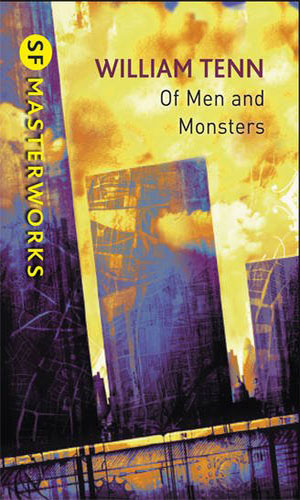
If you don't fancy buying the complete works, his only novel, Of Men and Monsters, is available in the superb SF Masterworks Series. (It is also included in Here Comes Civilization, and illustrated on the cover to that book, shown above):
Mankind consisted of 128 people.

The sheer population pressure of so vast a horde had long ago filled over a dozen burrows. Bands of the Male Society patrolled the outermost corridors with their full strength, twenty-three young adult males in the prime of courage and alertness. They were stationed there to take the first shock of any danger to Mankind, they and their band captains and the youthful initiates who served them.

Eric the Only was an initiate in this powerful force.
Giant aliens have invaded Earth and taken over all our resources. Nothing like a war can be said to have taken place: the aliens are too huge and advanced even to recognize us as intelligent. Human beings are reduced to living, mouselike, in burrows in the walls of alien houses. (Some editions of the novel carry the alternative title The Men in the Walls.) This is Tenn at his most Swiftian, ruthless in the accuracy of his satire. Like the mating cycle of the Venusian Plookh, the anthropology of his parasitic Mankind is worked out with a rigour that probably owes something to the influence of his scientist brother, Morton. It's a very funny, but sometimes dark, book, and makes a great introduction to Tenn's work.

It's about time I did an entry on a living author, so next time I will be blogging about the first novel of an eminent British scholar of Arabic literature, a fabulation set in medieval Cairo.