Showing posts with label Gothic. Show all posts

Thursday, 2 January 2014

Robert Aickman: Cold Hand in Mine

The book that has prompted the revival of this blog is a collection of short stories called Cold Hand in Mine by Robert Aickman.

I first heard of Aickman from a gifted student with an interest in the fantastic: he was in the tradition of M.R James, my student said, but his books were practically impossible to get hold of. I'm always annoyed when people claim to know authors too obscure even for me, and to prove a point I dug around in my ghost-story anthologies and found a couple of Aickman stories. In comparison with James, whose work I've loved since my teens, and who may one day feature in this blog himself (though his cult status is dubious), I found them a bit disappointing, with inconclusive plots and a vaguely spooky atmosphere that didn't quite precipitate into genuine manifestations. But then, as tends to happen, the name kept cropping up - in fact, as we shall see, he's developing quite a presence on the web. And Faber and Faber, who publish my poetry, brought out three volumes of his stories in their print-on-demand series Faber Finds (hence the generic-looking cover in the image shown here).

I now realize I was reading those other stories with the wrong expectations. Aickman isn't really a ghost-story writer, and his writing seems more a reaction against James's work than a development of it. Take 'The Swords', which opens the volume - the opening sentence, in fact: "My first experience?" the narrator asks. Yes, he is talking about sex, a subject James scrupulously avoided. He's looking back on his early life as a travelling salesman, staying in squalid lodgings in postwar provincial towns. James's protagonists were often displaced, too, but their lodgings, though bleak, were usually picturesque with it: the East Anglian settings of 'O Whistle and I'll Come to You,My Lad' and 'A Warning to the Curious' are far removed from... Wolverhampton.

Not knowing the town at all, I had drifted into the rundown area up by the old canal. The main streets were quite wide, but they had been laid out for daytime traffic to the different works and railway yards, and were now quiet and empty, except for the occasional lorry and the boys and girls playing around at some of the corners. The narrow streets running off contained lines of small houses, but a lot of the hosues were empty, with windows broken, or boarded up, and holes in the roof. I should have turned back. but for the sound made by the fair; not pop songs on the amplifiers, and not the poundings of the old steam organs, but more a sort of high tinkling, which somehow fitted in with the warm evening and the rosy twilight.

The protagonist goes to the fair and is admitted to a tent where an all-male audience is watching, and taking part in a bizarre show, egged on by a rough-looking impressario. I'd call it indescribable except that Aickmann describes it in vivid detail: the girl in green face-powder and revealing, if tatty, costume, sprawled in a canvas chair on the stage, the pile of swords, 'stacked criss-cross, like cheese straws' with which the men are invited to stab her, without, apparently, any ill-effect. The narrator flees before his turn comes round, but later meets the impresario and the girl in a cafe, and is coaxed into making a private arrangement.

'The Swords' doesn't try to hide its Freudian symbolism, or the sexual nature of the narrator's fascination with the girl and her act. You could describe it as an allegorical account of a young man losing his virginity to a prostitute, but such a label would nothing to dispel its strangeness or the shocking nature of its ending. Sex and death are combined in a totally unexpected way. It's one of the most disturbing stories I've ever read, and, for me, the best in the book, though some of the others run it close. 'The Hospice' tells of a man who loses his way while driving and ends up having to stay the night in a very unhomely hotel / institution; it has a typical Aickman open ending, though in this case I have my own theory as to what is going on. An example of his anti-Jamesianism is the way the temperature, here and in some other stories, is unnaturally hot instead of unnaturally cold as one might expect - he likes to make you sweat rather than shiver. 'The Same Dog' is a great modern fairy story; as Diane Purkiss points out in her excellent book Fairies and Fairy Stories: A History, fairies and ghosts are almost indistinguishable in some folk tales. Finally, 'The Clock-Watcher', the second of two stories with a strong German influence, uses the uncanny imagery of clocks to brilliant effect, and has a superbly handled unreliable narrator, making the conclusion, once again, highly elusive. I should add that Aickman is a writer every bit as sophisticated as any of his literary-fiction contemporaries, in style, technique and characterization.

I am a bit slow catching on to the Aickman cult. You can find a lot about him on the web, including a bibliographical database and a recent radio programme on him by the writer Jeremy Dyson on BBC iPlayer. He lived from 1914-1981, was a key figure in the conservation of Britain's inland waterways, and wrote forty-eight stories as well as a novel, The Late Breakfasters and a novella The Model: A Novel of the Fantastic. From one of the sites I learn that his mother left home when he was in his teens and his father left not long afterwards, leaving the boy to look after himself in the family home: it's the kind of grim eccentricity you might find in his own stories. His Collected Stories are out of print and can only be obtained second-hand at exorbitant prices. Faber are doing a tremendous service by making these three volumes available; my first reaction on finishing Cold Hand in Mine was to order the other two, The Unsettled Dust and The Wine-Dark Sea.

Next time, I'll be writing about a dark and very original adult fairy-tale by a little-known modernist poet.

Sunday, 19 February 2012

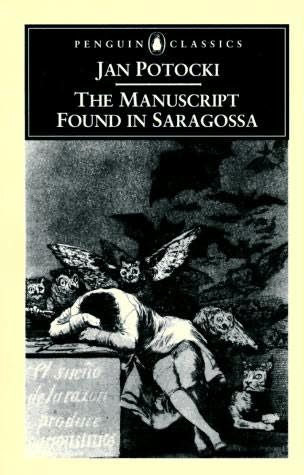
Jan Potocki:The Manuscript Found in Saragossa

When the chest was opened, a skeleton appeared, who came towards me in a menacing way. I drew my sword. The skeleton ripped off its left arm, and, using it as a weapon, launched a furious attack on me. I put up a good fight, but a second skeleton emerged from the chest, tore a rib off the the first skeleton and hit me over the head with it. I grabbed it by the throat but it clasped me in its fleshless arms and tried to throw me to the ground. I managed to get clear of it, but a third skeleton emerged from the trunk to join the other two. Then the other three appeared. Seeing no chance of coming away alive from so unequal a combat, I fell to my knees and begged the princess to spare me.
   The princess ordered the skeletons to return to the chest, then said, 'Romati, never forget as long as you live what you have seen here.'
   As she said this she grasped my arm. I felt it burn to the bone and I fainted.
This story is told by Giulio Romati to the gypsy chief Avadoro in a Spanish inn. Or rather it is being retold by Avadoro in the gypsy camp. to Alphonse van Worden, a young Belgian on his way to take up a commission in the Spanish army. Alphonse's story is part of a manuscript found by a French army officer after the siege of Saragossa in 1809, and supposedly written some decades earlier. The whole nest of stories constitutes the novel called the Manuscript Found in Saragossa by Jan Potocki. As a matter of fact, as Alphonse points out to Avadoro, the story of Giulio Romati, the ghostly princess and her retinue of skeletons comes from a collection of stories by a writer called Happel or Happelius. Saragossa is nothing if not intertextual, an anthology of weird, comic and sensational tales from across Europe. Like its modern British descendant, Robert Irwin's The Arabian Nightmare, it delights in the multiplicity of narrative, the way stories can hide inside other stories. And for Potocki as for Irwin dreams are stories too, the two used almost interchangeably to challenge our sense of reality.

Alphonse's journey to his regiment takes him across dangerous country. A bandit chief called Zoro has been terrorizing the area and is still at large, though his two brothers have been hanged and are now dangling grotesquely from a gibbet in a remote valley in the mountains. Alphonse's servants disappear, and he is forced to put up for the night at an abandoned inn. Lying in the dark he hears a clock strike midnight, the prelude to the first of his adventures. He is taken by a black maid to meet two beautiful Moorish women who are apparently staying at the inn in a luxurious room. They entertain him lavishly and tell him (of course) their story. They are Emina and Zubeida, daughters of the Great Sheikh of the Gomelez, who ruled this area in the days of the Moorish hegemony in Spain. Furthermore, there are related to Alphonse himself, cousins on his mother's side. Leaving aside the ties of kinship, he is infatuated with them, and promises on his honour as an officer never to reveal the details of their encounter. They part, he falls asleep - and wakes underneath the gibbet with the two brothers of Zoro dangling above him.

Are Emina and Zubeida what they seem, or are they demons, or the ghosts of the two hanged bandits? Alphonse meets a possessed man who has had a similar encounter; the mysterious women turn up again, and their flirtation becomes more serious. Encounters dissolve into dreams, and dreams keep leading him to the gibbet with its two corpses. Alphonse meets the gypsies, only to find that Avadoro's daughters bear an uncanny resemblance to Emina and Zubeida. Everyone has a story to tell and every story seems to have another one inside it.

Saragossa may sound like a work of postmodern metafiction, but it was written in the early nineteenth century. Potocki was a wealthy Polish aristocrat, a pioneer of Egyptology and ethnology, who established an independent press and reading room as well as flying over Warsaw in a hot-air balloon, and is said to have committed suicide with a silver bullet he forged himself out of his sugar bowl. The book is a compendium of Gothic themes, a guided tour of the state of supernatural fiction in the Romantic Age (gaining much of its effectiveness from the dry, understated style in which it relates extraordinary events), but it's also a document of the European Enlightenment, shrewdly interrogating the dreamy values of an old superstitious Europe to see what they amount to in the morning light. It's no coincidence that the basic story is set in Spain, with its ancient ideals of chivalry and honour. Spain is on the edge of Europe, and, as the story of the Great Sheikh of the Gomelez reminds us, has a complex religious and cultural heritage. The encounters and stories constantly pit Christian Europe against its Others, gypsies, Muslims and Jews (Ahasuerus, the Wandering Jew, is an important character). Bizarre as the stories are, they often begin unsensationally with an account of the narrator's upbringing; Potocki, in a thoroughly Enlightened way, is exploring the influence of education on an individual's life and character. At the centre of this exploration is Alphonse himself, whose father, an obsessive duellist, has brought him up to believe that honour and courage are the most important manly values. Saragossa is Alphonse's bildungsroman, his madly elaborate coming-of-age story, at the end of which he will realize that honour is not an infallible guide to behaviour and that, in a world where nothing is what it seems, reason is of more use.

I have now covered ten titles in White Threshold, starting with the historical epic The Man on a Donkey, and concluding with another equally grand epic, the first pre-twentieth-century, non-English-language title I have covered. I'm taking a break now, after which I hope to have some news about the future of the blog.

Monday, 23 January 2012

Shirley Jackson: We Have Always Lived in the Castle

We Have Always Lived in the Castle
Merricat, said Connie, would you like a cup of tea?
Oh no,said Merricat, you'll poison me.
Merricat, said Connie, would you like to go to sleep?
Down in the boneyard ten feet deep!
In Riddley Walker, Russell Hoban makes powerful use of children's rhymes to create atmosphere. In We Have Always Lived in the Castle, there's only one rhyme, but it re-echoes throughout, epitomizing the novel's darkly naive tone. Merricat is Mary Katherine Blackwood, the eighteen-year-old narrator, and Connie is her beloved elder sister Constance. The Castle is the grand house they live in with their disabled Uncle Julian; because we see them through Merricat's eyes, and she is clearly quite disturbed, we never really see the Castle and its adjacent village as part of modern America - they are always on the verge of becoming a fantasy realm. Six years ago the rest of the Blackwood family were murdered. Constance was accused of the crime but acquitted for lack of evidence. The villagers, whose children taunt Merricat with the rhyme above, still hate and fear both of them. This is the situation when a cousin, Charles, comes to visit, upsetting the balance of this strange household.

The Gothic has been an important strain in American literature since well before its two great nineteenth-century exponents Poe and Hawthorne. But those two writers stand for the two main currents in American Gothic, the Southern and New England varieties. After all, the Gothic depends on a strong sense of the past, and the South and New England are the oldest parts of the United States, the areas where the image of a castle or a grand old house haunted by ancestral ghosts seems least incongruous. Also both have strong religious traditions and the sense of evil that goes with them. And Gothic without a sense of evil is just a kind of literary fancy dress.

Shirley Jackson was born in California, but lived in Vermont. In her six novels you can see her working her way into the New England Gothic tradition, creating more and more convincingly a world that is both magical and contemporary. And she has the sharpest eye for evil of any writer I can think of. For Jackson, it doesn't come as buckets of blood and torture porn and it never comes unmixed; there are no monsters in her work. There is evil in the Castle, but there is also charm, humour and a particularly touching portrayal of sisterly love. And there is evil outside the Castle, too, in the villagers' hatred - understandable in its origin but always ready to go out of control.

Much of the fascination of the book is in Merricat's voice, childlike in spite of her age. Jackson is superb on children, and wrote a couple of books about her own experiences as a mother: one of them is called life Among the Savages, and as this title implies, her theme, for all the love and humour with which she writes, is that they are as prone to evil as the rest of us - indeed, it's more obvious in children because they haven't learned to hide it. The children persecute Merricat with their rhymes and her own vindictiveness towards Charles is inseparable from her childish preoccupation with the comfortable rituals of her life.

Castle is a short novel, almost a novella, and utterly gripping. The major twist in the plot is one that almost every reader will have seen coming long before, but there is another, almost incidental, surprise which is quite devastating. It's the work of a brilliant writer at the height of her powers: sadly,she died soon after completing it, at the age of 49, worn out by psychological problems and abuse of prescription drugs. Her vision cannot have been a comfortable one to live with, and it says a lot for her both as a person and an artist that her work, though always disturbing, is never depressing. (Much of it is extremely funny.) She is better known in the US than the UK - I'd never heard of her till a reader recommended her on one of the Guardian Books blogs. Even there, her reputation seems to rest mostly on one short story, 'The Lottery', and on her novel The Haunting of Hill House, which was made into a successful film. There have been rumours of a forthcoming film of Castle for a long time now, but I haven't heard of a release date yet. I'll return to Jackson in the future, as I will to several of the other authors I cover in this blog.

Next time, a quirky thriller by an imaginative and immensely prolific US novelist who excels across several genres.