Thursday, 2 January 2014

Robert Aickman: Cold Hand in Mine

The book that has prompted the revival of this blog is a collection of short stories called Cold Hand in Mine by Robert Aickman.

I first heard of Aickman from a gifted student with an interest in the fantastic: he was in the tradition of M.R James, my student said, but his books were practically impossible to get hold of. I'm always annoyed when people claim to know authors too obscure even for me, and to prove a point I dug around in my ghost-story anthologies and found a couple of Aickman stories. In comparison with James, whose work I've loved since my teens, and who may one day feature in this blog himself (though his cult status is dubious), I found them a bit disappointing, with inconclusive plots and a vaguely spooky atmosphere that didn't quite precipitate into genuine manifestations. But then, as tends to happen, the name kept cropping up - in fact, as we shall see, he's developing quite a presence on the web. And Faber and Faber, who publish my poetry, brought out three volumes of his stories in their print-on-demand series Faber Finds (hence the generic-looking cover in the image shown here).

I now realize I was reading those other stories with the wrong expectations. Aickman isn't really a ghost-story writer, and his writing seems more a reaction against James's work than a development of it. Take 'The Swords', which opens the volume - the opening sentence, in fact: "My first experience?" the narrator asks. Yes, he is talking about sex, a subject James scrupulously avoided. He's looking back on his early life as a travelling salesman, staying in squalid lodgings in postwar provincial towns. James's protagonists were often displaced, too, but their lodgings, though bleak, were usually picturesque with it: the East Anglian settings of 'O Whistle and I'll Come to You,My Lad' and 'A Warning to the Curious' are far removed from... Wolverhampton.

Not knowing the town at all, I had drifted into the rundown area up by the old canal. The main streets were quite wide, but they had been laid out for daytime traffic to the different works and railway yards, and were now quiet and empty, except for the occasional lorry and the boys and girls playing around at some of the corners. The narrow streets running off contained lines of small houses, but a lot of the hosues were empty, with windows broken, or boarded up, and holes in the roof. I should have turned back. but for the sound made by the fair; not pop songs on the amplifiers, and not the poundings of the old steam organs, but more a sort of high tinkling, which somehow fitted in with the warm evening and the rosy twilight.

The protagonist goes to the fair and is admitted to a tent where an all-male audience is watching, and taking part in a bizarre show, egged on by a rough-looking impressario. I'd call it indescribable except that Aickmann describes it in vivid detail: the girl in green face-powder and revealing, if tatty, costume, sprawled in a canvas chair on the stage, the pile of swords, 'stacked criss-cross, like cheese straws' with which the men are invited to stab her, without, apparently, any ill-effect. The narrator flees before his turn comes round, but later meets the impresario and the girl in a cafe, and is coaxed into making a private arrangement.

'The Swords' doesn't try to hide its Freudian symbolism, or the sexual nature of the narrator's fascination with the girl and her act. You could describe it as an allegorical account of a young man losing his virginity to a prostitute, but such a label would nothing to dispel its strangeness or the shocking nature of its ending. Sex and death are combined in a totally unexpected way. It's one of the most disturbing stories I've ever read, and, for me, the best in the book, though some of the others run it close. 'The Hospice' tells of a man who loses his way while driving and ends up having to stay the night in a very unhomely hotel / institution; it has a typical Aickman open ending, though in this case I have my own theory as to what is going on. An example of his anti-Jamesianism is the way the temperature, here and in some other stories, is unnaturally hot instead of unnaturally cold as one might expect - he likes to make you sweat rather than shiver. 'The Same Dog' is a great modern fairy story; as Diane Purkiss points out in her excellent book Fairies and Fairy Stories: A History, fairies and ghosts are almost indistinguishable in some folk tales. Finally, 'The Clock-Watcher', the second of two stories with a strong German influence, uses the uncanny imagery of clocks to brilliant effect, and has a superbly handled unreliable narrator, making the conclusion, once again, highly elusive. I should add that Aickman is a writer every bit as sophisticated as any of his literary-fiction contemporaries, in style, technique and characterization.

I am a bit slow catching on to the Aickman cult. You can find a lot about him on the web, including a bibliographical database and a recent radio programme on him by the writer Jeremy Dyson on BBC iPlayer. He lived from 1914-1981, was a key figure in the conservation of Britain's inland waterways, and wrote forty-eight stories as well as a novel, The Late Breakfasters and a novella The Model: A Novel of the Fantastic. From one of the sites I learn that his mother left home when he was in his teens and his father left not long afterwards, leaving the boy to look after himself in the family home: it's the kind of grim eccentricity you might find in his own stories. His Collected Stories are out of print and can only be obtained second-hand at exorbitant prices. Faber are doing a tremendous service by making these three volumes available; my first reaction on finishing Cold Hand in Mine was to order the other two, The Unsettled Dust and The Wine-Dark Sea.

Next time, I'll be writing about a dark and very original adult fairy-tale by a little-known modernist poet.

White Threshold Reopens

In my last posting, in March 2012, I announced the temporary closure of White Threshold and hinted that I might have some exciting news soon. Then nothing till now, nearly two years later. What had happened was that I had received an offer to move the blog to The Guardian's website, where I would receive a small fee for writing it and, more significantly, could expect many more readers. Over the next couple of months, I emailed my contact at The Guardian several times asking for further details, but received no reply. It became clear that nothing was going to come of the idea, and I gave up. I later found out that my contact had left the paper and my chance had gone. I didn't resume White Threshold, partly because the initial enthusiasm had died away, but mostly because I was finding it very time-consuming. Many of the books I reviewed were ones I hadn't read for some time, and I was feeling compelled to reread them specially, which was not easy to fit in with my academic work, which requires a great deal of reading of different material.

Since then,I have occasionally thought of resuming the blog, particularly when, as has just happened, I find myself reading a book that seems perfect for it. Also, there are still quite a few writers I originally intended to cover but didn't get round to, as well as, eventually, some other books by writers I've already covered. Maybe the answer is to resume White Threshold but ignore the standard blogging advice that insists you have to update at regular intervals or risk losing your readers. An occasional update is surely better than no updates at all.

Friday, 2 March 2012

Intermission

White Threshold is taking a break. I hope to be back with more news shortly. My other literary blog, Starling City, is still up and running, or at least ambling.

Sunday, 19 February 2012

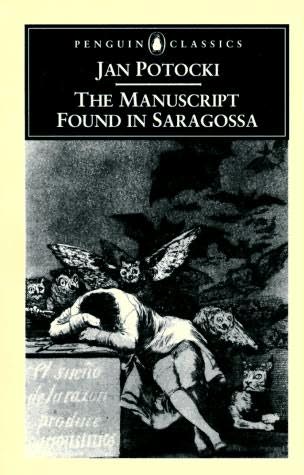
Jan Potocki:The Manuscript Found in Saragossa

When the chest was opened, a skeleton appeared, who came towards me in a menacing way. I drew my sword. The skeleton ripped off its left arm, and, using it as a weapon, launched a furious attack on me. I put up a good fight, but a second skeleton emerged from the chest, tore a rib off the the first skeleton and hit me over the head with it. I grabbed it by the throat but it clasped me in its fleshless arms and tried to throw me to the ground. I managed to get clear of it, but a third skeleton emerged from the trunk to join the other two. Then the other three appeared. Seeing no chance of coming away alive from so unequal a combat, I fell to my knees and begged the princess to spare me.
   The princess ordered the skeletons to return to the chest, then said, 'Romati, never forget as long as you live what you have seen here.'
   As she said this she grasped my arm. I felt it burn to the bone and I fainted.
This story is told by Giulio Romati to the gypsy chief Avadoro in a Spanish inn. Or rather it is being retold by Avadoro in the gypsy camp. to Alphonse van Worden, a young Belgian on his way to take up a commission in the Spanish army. Alphonse's story is part of a manuscript found by a French army officer after the siege of Saragossa in 1809, and supposedly written some decades earlier. The whole nest of stories constitutes the novel called the Manuscript Found in Saragossa by Jan Potocki. As a matter of fact, as Alphonse points out to Avadoro, the story of Giulio Romati, the ghostly princess and her retinue of skeletons comes from a collection of stories by a writer called Happel or Happelius. Saragossa is nothing if not intertextual, an anthology of weird, comic and sensational tales from across Europe. Like its modern British descendant, Robert Irwin's The Arabian Nightmare, it delights in the multiplicity of narrative, the way stories can hide inside other stories. And for Potocki as for Irwin dreams are stories too, the two used almost interchangeably to challenge our sense of reality.

Alphonse's journey to his regiment takes him across dangerous country. A bandit chief called Zoro has been terrorizing the area and is still at large, though his two brothers have been hanged and are now dangling grotesquely from a gibbet in a remote valley in the mountains. Alphonse's servants disappear, and he is forced to put up for the night at an abandoned inn. Lying in the dark he hears a clock strike midnight, the prelude to the first of his adventures. He is taken by a black maid to meet two beautiful Moorish women who are apparently staying at the inn in a luxurious room. They entertain him lavishly and tell him (of course) their story. They are Emina and Zubeida, daughters of the Great Sheikh of the Gomelez, who ruled this area in the days of the Moorish hegemony in Spain. Furthermore, there are related to Alphonse himself, cousins on his mother's side. Leaving aside the ties of kinship, he is infatuated with them, and promises on his honour as an officer never to reveal the details of their encounter. They part, he falls asleep - and wakes underneath the gibbet with the two brothers of Zoro dangling above him.

Are Emina and Zubeida what they seem, or are they demons, or the ghosts of the two hanged bandits? Alphonse meets a possessed man who has had a similar encounter; the mysterious women turn up again, and their flirtation becomes more serious. Encounters dissolve into dreams, and dreams keep leading him to the gibbet with its two corpses. Alphonse meets the gypsies, only to find that Avadoro's daughters bear an uncanny resemblance to Emina and Zubeida. Everyone has a story to tell and every story seems to have another one inside it.

Saragossa may sound like a work of postmodern metafiction, but it was written in the early nineteenth century. Potocki was a wealthy Polish aristocrat, a pioneer of Egyptology and ethnology, who established an independent press and reading room as well as flying over Warsaw in a hot-air balloon, and is said to have committed suicide with a silver bullet he forged himself out of his sugar bowl. The book is a compendium of Gothic themes, a guided tour of the state of supernatural fiction in the Romantic Age (gaining much of its effectiveness from the dry, understated style in which it relates extraordinary events), but it's also a document of the European Enlightenment, shrewdly interrogating the dreamy values of an old superstitious Europe to see what they amount to in the morning light. It's no coincidence that the basic story is set in Spain, with its ancient ideals of chivalry and honour. Spain is on the edge of Europe, and, as the story of the Great Sheikh of the Gomelez reminds us, has a complex religious and cultural heritage. The encounters and stories constantly pit Christian Europe against its Others, gypsies, Muslims and Jews (Ahasuerus, the Wandering Jew, is an important character). Bizarre as the stories are, they often begin unsensationally with an account of the narrator's upbringing; Potocki, in a thoroughly Enlightened way, is exploring the influence of education on an individual's life and character. At the centre of this exploration is Alphonse himself, whose father, an obsessive duellist, has brought him up to believe that honour and courage are the most important manly values. Saragossa is Alphonse's bildungsroman, his madly elaborate coming-of-age story, at the end of which he will realize that honour is not an infallible guide to behaviour and that, in a world where nothing is what it seems, reason is of more use.

I have now covered ten titles in White Threshold, starting with the historical epic The Man on a Donkey, and concluding with another equally grand epic, the first pre-twentieth-century, non-English-language title I have covered. I'm taking a break now, after which I hope to have some news about the future of the blog.

Friday, 10 February 2012

Muriel Spark: Robinson

In my posting on Riddley Walker, I mentioned my love of the kind of books that have maps at the front. Take a look at this one - not just a map but an allegorical map. It's obvious that the island represents a man, and both, like the novel, are called Robinson, a literary allusion that couldn't be more obvious. In 1958, it was unusual to flout the conventions of realism like this - Thomas Pynchon and John Barth were being greatly daring when they did something similar some years later, in V (1963) and Giles Goat-Boy (1966). Muriel Spark, a poet turned novelist, was in the process of working out for herself the genre we sometimes call, in a term invented by the critic Robert Scholes, fabulation. As practised by her, we might define this as about two parts allegory to three parts comedy, the comedy somehow both exuberant and deadpan. The map says it all, with its Treasure-Island fantasy ('Secret Tunnels'), precisely worked-out geography described in slightly poetic language ('Blue & Green Lake', 'Paths to Snow-White Beach'), and hilarious allegorical features ('The West Leg', 'The North Knee').

Three passengers survive from the plane that crashed on Robinson's eponymous island: January Marlow, a youngish widow and the novel's narrator, Tom Wells, an unpleasant salesman and charlatan specializing in lucky charms, and Jimmie Waterford, a Dutchman despite his name, who turns out to be a relative of Robinson's. There is one other character, the boy Miguel who is the son of one of the pomegranate planters who worked on the island before Robinson purchased it, and now cared for by Robinson. At first life is idyllic. There is ample food and nothing much to do until the pomegranate boat arrives on its scheduled visit in August, apart from milking the goat, listening to Robinson's Rossini records, and discussing relationships and theology. Robinson and January are both Catholics, the former more or less lapsed, the latter, like Spark herself, a recent convert. Robinson has retreated to the island because of his disillusionment with aspects of his religion, and the moral implications of retreat from what one finds unacceptable form the novel's theme. 'No man is an island,' Jimmie reminds him, but Robinson is doing his best to become one. Like January, whose name he initially mistakes for the month and place of her birth, he is a category error in human form.

Two-thirds of the way through this short book, Robinson disappears, and the plot shifts abruptly into a not very mysterious adventure mystery. It is always more of a romp, if any novel so intellectually sophisticated and elegantly written (Spark, at her best, is one of the great prose stylists) can be described in such terms. As well as the secret passages, there is blood, a volcano, and a lot of tension and intrigue between the one woman and two men, each of whom might be responsible for Robinson's death. To complicate matters, January is attracted to the morally ambiguous Jimmie - whose broken English also contributes to the comic tone:
   I dressed quickly and went in search of Jimmie. He was drinking brandy in Robinson's study. When he saw me he said:
   'Alas, I am abased to the servile floor.'
   I shivered, for in my haste I had not dried myself properly. I said, 'I'd like a drink.'
   He poured some brandy for me. 'I lose my nerves.'
Robinson was published four years later than that other desert-island allegory Lord of the Flies. One could read something into that, perhaps: an island suddenly shorn of its global empire returning to and revising the island fantasies that had sustained the spirit of imperial adventure from the start (The Tempest, Robinson Crusoe, Treasure Island). Another island novel, Joseph Conrad's Victory (1915), in which Axel Heyst's attempt to shut himself off from the wickedness of the world is rudely interrupted by the arrival of three strangers, must surely have been an influence.

Muriel Spark is the most established writer I have covered in White Threshold. By the end of her career she was Dame Muriel, author of The Prime of Miss Jean Brodie, which became an Oscar-winning film, rich and internationally famous. When she wrote Robinson, her second novel, she was none of these things. And I believe it's valid to stake a claim for cult status that applies to only part of a writer's work. Spark's five early novels, from The Comforters (1957) to The Bachelors (1960), together with the stories collected in The Go-Away Bird and Other Stories (1958) began an extraordinary outpouring of dark, funny, risk-taking fiction. Once this surge had reached its climax with the success of Brodie (1961) and The Girls of Slender Means (1963), she never again returned to the same level of sustained creativity, though there are isolated successes like A Far Cry from Kensington (1988). The pre-Brodie novels have received comparatively little attention, and Robinson may well be the least known of them all. Hardly surprising in some ways: its nuanced metaphysical debate, adventure-story trappings, and high comedy played with a straight face are, even by Spark's standards, distinctly unusual.

Nine titles done now, and for the tenth I have reserved something special. My first pre-twentieth-century text is also the first not to have been written in English: a pan-European metafictional epic.

Wednesday, 1 February 2012

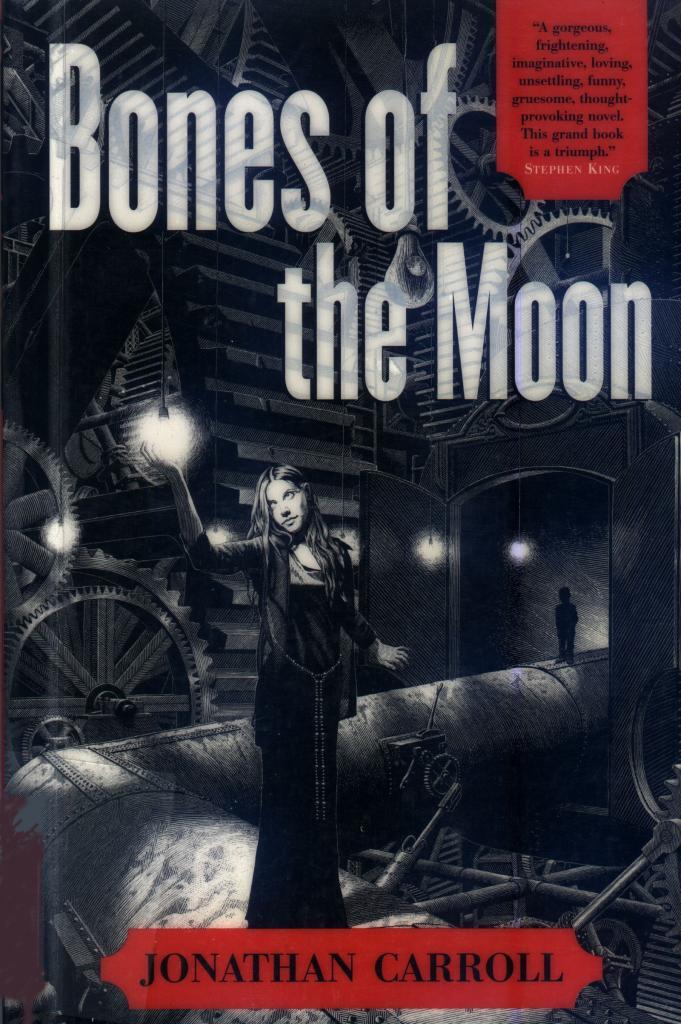
Jonathan Carroll: Bones of the Moon

Bones of the MoonLike most writers, I've woken up many times in the grip of a dream that seems like perfect material for a novel or a poem. Maybe you get as far as jotting it down before going back to sleep. When you wake up again, there's nothing there that makes sense. Dreams are fascinating to live through, but nonsense in daylight. Or, worse, they make too much sense - it's embarrassingly obvious what waking thoughts and experiences got translated into them. Either way they don't generally make good literature. And yet the urge to use them remains. Dreams are narratives, after all, and their very strangeness gives them the element of surprise we value in fiction. For writers who are fascinated by their own art (and what writer isn't?) they make a great metaphor for writing itself. They are used as a conventional framing device in,for example, Piers Plowman, The Divine Comedy, Alice. When we read them in this form, we're well aware of the conventions; the dream is not a real dream, and only retains those dreamlike characteristics that fit the writer's purpose.

In The Arabian Nightmare, Robert Irwin concentrates on two characteristics of dreams, the difficulty the sleeper sometimes has in telling sleep from waking, and the nesting of dreams within dreams. There is also a dreamlike strangeness due to the magical element that appears from time to time - but because of the blurring of sleep and waking, we never know if it's real or dream magic. Irwin's dreams are conventional - we are well aware that they are just another mode of storytelling. But there is one novel I know where the dreams are both an effective part of the narrative, and genuinely dreamlike.

Cullen James is a happily married woman living in New York with her husband and baby daughter. But there are a few shadows in her life. In the apartment downstairs, as we learn in the opening sentence of Bones of the Moon, a boy has gone crazy and killed his mother and sister with an axe. Before her marriage, Cullen herself had a series of unhappy relationships, culminating in an abortion about which she still has feelings of guilt. A charismatic but frightening film director is making insistent passes at her. And Cullen is suffering from her own version of the Arabian Nightmare, a series of intensely vivid dreams which connect together to form a continuous narrative:
How strange it was to eat glass and light. All of the food on the table was laid out beautifully and precisely. The spread would have looked delicious if everything wasn't transparent; splashing the light from the icy chandelier hung high and huge over the crystalline dining-table.
     Pepsi picked up his clear hot-dog wrapped in its clear bun and took a big bite. His walking stick leaned against the chair and was the only patch of colour around. Exposed to the sun for days on our walk here, the sticks had burned or ripened... changed from their original grey-brown to a deep, vivid purple.
     Sizzling Thumb had mine over his lap and kept petting it like a cat. 'Your tapes arrived without chicken.'
The dreams take the form of a quest through a magical land called Rondua. Cullen's companions are a number of talking animals, notably a hat-wearing dog called Mr Tracy, and a small boy, Pepsi, who is her son in the dreamworld (and, as we soon realize, a projection of her guilt about the abortion). They are searching for five magic tokens called the Bones of the Moon. And for all their surreal quality the dreams have a consistent structure: as they travel through the different regions of Rondua and collect the bones, the dream story moves towards its climax, a confrontation with the villainous Jack Chili. Meanwhile, Cullen's waking life is becoming more disturbed. The 'axe-boy', now in prison, has begun a worryingly obsessive correspondence with her. She seems to be developing supernatural powers; and the film director, Weber Gregston, starts having the same dreams.

Bones of the Moon is a brilliantly constructed fantasy thriller, though it teeters on the edge of sentimentality at times. But what really sets it apart is the portrayal of the dreams. Stephen King, an admirer of the book, has written: 'When has any novelist last caught so perfectly the weird but matter-of-fact experience of dreaming?' Never,as far as I know. These are the most dreamlike dreams I have ever seen in fiction, as absurd as they are compelling.

It's a nice piece of synchronicity that the author shares his surname with the author of the Alice books (though Lewis Carroll,of course,is a pen-name, while Jonathan is a Carroll by birth). He has written some fifteen novels, and all of those I've read show the same dazzling originality and imagination that characterize Bones of the Moon. Neil Gaiman, as well as King, is a fan. Carroll's first two novels, by the way, are published in the Fantasy Masterworks series, which I've mentioned before: I intend to blog about one of them at a later date.

Next time I'll be writing about an early, lesser-known novel by a major British post-war novelist.

Monday, 30 January 2012

Patrick Hamilton: Hangover Square

Hangover Square
Depersonalization is a psychological symptom in which the sufferer's sense of self is affected. The world suddenly feels remote and unreal. According to Wikipedia, it is the third most common psychological symptom, after anxiety and feelings of depression; it can be an indication of many underlying conditions, or induced by drugs, sleeplessness, shock, or even voluntarily, for example by meditation. If involuntary, it can be an unpleasant, alarming experience: I have suffered from it myself. So, undoubtedly, had Patrick Hamilton, who in his novel Hangover Square, gives a series of brilliant descriptions of it:
Like a camera. but instead of an exposure having been made the opposite had happened - an inclosure - a shutting down, a locking in. A moment before his head, his brain, were out in the world, seeing, hearing, sensing objects directly; now they were enclosed behind glass (like Crown jewels, like Victorian wax fruit), behind a film - the film of the camera, perhaps, to continue the photographic analogy - a film behind which all things and people moved eerily, without colour, vivacity or meaning, grimly, puppet-like, without motive or conscious volition of their own...
George Harvey Bone is a big, clumsy, unprepossessing man, living on a small inheritance in Earl's Court. His life revolves around two obsessions, the unpleasant Netta, whom he loves and despises at the same time, and the drink which is his only consolation for her rejection of him, as well as the main interest the two have in common. Netta is at the centre of a small group of hard-drinking, idle friends who exploit Bone for his comparative prosperity while mocking him to his face. It is just after the Munich agreement; Netta and the friends are supporters of Chamberlain, admirers of Hitler and Mussolini, another reason Bone has for hating them. But they continue their round of the London pubs, with a couple of trips to Brighton thrown in, endlessly engaged in the kind of mean-minded drunken smalltalk which is Hamilton's great contribution to fictional dialogue. From time to time Netta has a fling with someone, never with Bone. And from time to time also, he has what he calls one of his dead moods, his attacks of depersonalization. At such moments, he feels an overwhelming compulsion to kill Netta, a certainty that he will in fact eventually kill her. Then the mood passes and he cannot remember anything about it.

Hangover Square is the darkest of Hamilton's novels. Unlike his other masterpieces Twenty Thousand Streets Under the Sky and The Slaves of Solitude, both of which I hope to blog about in the future, it has very little humour. But, for me, it's his greatest achievement, an unblinking examination of the alcoholic bohemian lifestyle he knew so well, and which eventually killed him. One reason for that is the use of depersonalization: has any other writer described this symptom so well? And yet I strongly suspect it's a common experience of writers, of creative people generally. To write really effectively, you have to be able to drain the emotion from a scene, to look at it as if you weren't really feeling it. That way it becomes strange and new. The term used in literary criticism is defamiliarization - but that's only the literary manifestation of depersonalization. Hamilton gives us a defamiliarized Earl's Court through the eyes of a depersonalized George Harvey Bone. He takes the emotion out so that it will be all the more effective when it rushes back in again:
It almost knocked him down. It made him reel. It was as though he had been hit by something. And yet he knew what it was. It was only his head, cracking back. And with the crack everything came flooding, rushing, roaring back - noise, colour, light, the fury of the real, everyday world.
Hamilton was a successful writer in his lifetime; his plays Gaslight and Rope were both made into films, and made him a wealthy man. But after his death, in 1962 at the age of 58, his reputation went into eclipse. Since then there have been sporadic attempts to revive it, and the current one seems, finally, to have taken off. Twenty Thousand Streets Under the Sky was dramatized on BBC Television a few years ago, and his major works are all in print, including the Gorse trilogy, which I haven't read, and which is less highly regarded than the other novels I've mentioned. I hope he is now back for good where he belongs, among the major British novelists of his era.

Next time, a surreal story about dreaming by a unique US fantasy novelist.