Showing posts with label Fantasy. Show all posts

Friday, 1 September 2017

Thinking Up Novels in the Bath

Mozart got his ideas while playing billiards, Lawrence Sterne while shaving.Luis Buñuel liked to sit on his own in a quiet bar sipping a dry martini. I seem to get mine in the bath. This is probably related to the fact that baths invariably send me to sleep, which is why I prefer showers on working days. On mornings when I have nothing pressing to do, I get in the bath, fall asleep, come round as the water becomes lukewarm and, lying there in a state somewhere between sleeping and waking, usually come up with another idea for a novel.

I have published two novels, twenty-five years apart and very different from each other. WHOM (1989) is a satirical romp about a womanizing US President who may or may not bring about an apocalyptic nuclear war by interfering in the politics of a fictitious Mediterranean island. Like so many first novels, it's a mish-mash of influences: Thomas Pynchon, Mikhail Bulgakov and Evelyn Waugh are the main ones I detect in it now. I still think it's quite funny - there's an extract from it here. The Book of the Needle (2014) is a more mature piece of work, a historical novel based on the story of the real-life 17th-century Welsh prophet and tailor Arise Evans; I researched it thoroughly and learned a lot about both history and fiction from the process, though I hoped, as with the earlier novel, to write something people would find funny and entertaining. Both novels could reasonably be said to have sunk without trace, and the process of writing a novel (two years for the first, four and a half for the second) is something I've found deeply disillusioning.

Yet I still dream of writing a novel. I read fiction constantly (whereas my poetry reading tends to be in bursts), and my love of narrative finds an outlet in many of my poems and poetic sequences. I have the poet's weakness of obsessing over phrases and details, and I find plots very difficult, which is why much of my recent work, in both poetry and fiction, has involved retelling existing stories. Otherwise, I think I have the makings of a novelist: I can write good prose and dialogue, invent characters, handle complex structures, and so on. The difficulty, as always, is to commit oneself to such a big project with no guarantee of finding a readership, or even a publisher, at the end of it. And the market has changed so much, and become so relentlessly commercial, over the past few years, that it seems harder than ever, especially for someone whose inclinations are towards the unfashionable modes of literary and (mildly) experimental fiction.

So I dream in the bath of a novel that I would enjoy enough to stick at it through all the uncertainties of the writing process, and might be able to sell at the end. Some of these ideas are old friends, which have surfaced many times before, only to be rejected for some difficulty or other, or because another one has come along which temporarily seems more exciting. Some are even things I have written already in a different genre, but which might be worth expanding into novel form. Some are obviously absurd, and yet, maybe with a little twist...

Here are some of them:

   An adaptation of my poetic sequence Mandeville, about the medieval traveller Sir John Mandeville.

   The autobiographical novel Starling City, about a breakdown I had in my early mid-twenties when I was living in 1980s Brighton. Perhaps combined with an old idea about a detective mystery in which the detective is a post-modernist who doesn't believe in truth.

   A historical novel about the early modern scientist Robert Hooke, about whom I have already written some poems.

   A novel based on the life of the food writer Elizabeth David, which I would fictionalize, combining her story with that of several other women of the time who had similarly adventurous lives.

   A historical thriller in which the protagonist is Christopher Marlowe, who narrates it in a voice borrowed from his namesake Philip Marlowe.

   A fantasy set in the world of pastoral in which everyone is either a shepherd or shepherdess, or pretends to be.

   A novel about the building of the great Welsh reservoirs.

   A novel based loosely on the life of W.S. Graham.

   A novel about a seventeenth-century astrologer and the cases he investigates.

   A ghost story with M.R.James as its protagonist.

   A alternative history novel in which the chess match between Fischer and Karpov, which was scheduled for 1975 but never took place, actually happens, in Cambridge where I was living at the time.

I think several of these ideas are plausible. But every time I contemplate putting in the work I remember my agent asking, of The Book of the Needle: "How are you going to sell this book?" And,not being able to think of an answer, I go back to writing poems, which I do at least have a publisher for.

Saturday, 22 March 2014

Hope Mirrlees: Lud-in-the-Mist

Lud-in-the-Mist is the capital of the free state of Dorimare, "scattered about the banks of two rivers, the Dapple and the Dawl":

The Dawl was the biggest river of Dorimare, and it became so broad at Lud-in-the-Mist as to give that town, twenty miles inland though it was, all the advantages of a port; while the actual seaport town itself was little more than a fishing village. The Dapple, however, which had its source in Fairyland (from a salt inland sea, the geographers held) and flowed subterraneously under the Debatable Hills, was a humble little stream and played no part in the commercial life of the town. But an old maxim of Dorimare bade one never forget that The Dapple flows into the Dawl.

We are in a Fantasyland, then, and an almost excessively charming one, whose inhabitants drink wild thyme gin and flower-in-amber, eat Moongrass cheese and smoked ham with pickled cowslips, and swear oaths like "Busty Bridget!" and "By My Great-Aunt's Rump". It's a kind of domestic Merrie England, not all that far from Tolkien's The Shire in its atmosphere, and with a touch of Shakespearean comedy, too. The hero, Nathaniel Chanticleer, a man of fifty, "rotund, rubicund, red-haired", has just been elected Mayor of this thoroughly bourgeois polis where the men are called Master, the married women Dame, everyone has an exaggerated respect for the Law, and the worst crime imaginable is to eat fairy fruit.

For, as the passage quoted above makes clear, this fantastic world has its dark side, the Fairyland where the River Dapple originates, on the other side of the Debatable Hills and the Elfin Marches. There was once commerce between the two, in the days of the legendary autocratic hunchback Duke Aubrey, whose sinister presence still haunts the psyches of the townspeople long after his mysterious disappearance: like the fairies themselves and their fruit, he embodies a chaotic force they dare not accommodate in their sunny lives. But it can't be suppressed for long. Mayor Nathaniel has a hidden neurosis, his obsession with a plangent note he once heard from an old lute, and this element of his personality seems to have been transferred to his son Ranulph, who is behaving strangely and claims to have eaten the fairy fruit. The respectable young ladies of Miss Primrose Crabapple's Academy go on the rampage; blood is seen leaking from a coffin; Nathaniel finds evidence of an old murder; and eventually he must journey to Fairyland itself in search of his missing son.

The central image of the book must owe something to Christina Rosetti's Goblin Market. More generally, it's in a tradition of fantasy that seeks to free the folklore of fairies from its sentimental trappings and recapture some of its old terror. In my last entry, on Robert Aickman, I mentioned Diane Purkiss's superb study of fairy stories; like Purkiss, Mirrlees understands the association of fairies with death. Her Fairyland is a land of the dead, and in order to be fully ourselves we have to reopen the borders and resume our relations with them, frightening as this is. If Lud-in-the-Mist seems cloying occasionally, the writing too pretty and whimsical, that's perhaps a consequence of Mirrlees's vision: for all the quaint comedy, the people of her world are suffering from a sickness, their failure to accept mortality and the violence, chaos and creative energy she sees as linked to it. They are meant to seem a little too good to be true.

Mirrlees was the author of a couple of other novels and what sounds like a very interesting modernist long poem called Paris. She lived with her former Cambridge tutor, the distinguished Classical scholar Jane Ellen Harrison, and was a respected figure in the intellectual scene of the early twentieth century, admired by Virginia Woolf for her elegance and erudition. Recently, Lud, first published in 1926, has been championed by Neil Gaiman, and reissued in Gollancz's Fantasy Masterworks series. (Sophie Toulouse's brilliant cover illustration, shown here - if you think it's a mis-shapen pineapple, look again - gives a slightly misleading impression of a book more erotic than it is.) There is also a biography of Mirrlees by Michael Swanwick, and a website devoted to her, maintained by Erin Kissane. Like Aickman, Mirrlees seems poised for a long-delayed breakthrough, and with equally good reason. While she can overwrite (and I wish she wouldn't use speech tags like "she dimpled") her prose in general has the imaginative precision you'd expect from a poet-novelist: the sun shining on the brick Guildhall makes it look "like a rotten apricot", doves "with the bloom of plums on their breasts" waddle "on their coral legs", and the city has "little open squares where comic baroque statues of dead citizens [hold] levees attended by birds and lovers and insects and children". Beneath the comedy is a deep intellectual seriousness. Lud-in-the-Mist, part fairy story, part whodunnit (you can tell it was written in the Golden Age of the English detective story) part existential allegory, is a true cult classic.

Next time, a contemporary British comic novel that draws on the experimental techniques of the OuLiPo group.

Thursday, 2 January 2014

Robert Aickman: Cold Hand in Mine

The book that has prompted the revival of this blog is a collection of short stories called Cold Hand in Mine by Robert Aickman.

I first heard of Aickman from a gifted student with an interest in the fantastic: he was in the tradition of M.R James, my student said, but his books were practically impossible to get hold of. I'm always annoyed when people claim to know authors too obscure even for me, and to prove a point I dug around in my ghost-story anthologies and found a couple of Aickman stories. In comparison with James, whose work I've loved since my teens, and who may one day feature in this blog himself (though his cult status is dubious), I found them a bit disappointing, with inconclusive plots and a vaguely spooky atmosphere that didn't quite precipitate into genuine manifestations. But then, as tends to happen, the name kept cropping up - in fact, as we shall see, he's developing quite a presence on the web. And Faber and Faber, who publish my poetry, brought out three volumes of his stories in their print-on-demand series Faber Finds (hence the generic-looking cover in the image shown here).

I now realize I was reading those other stories with the wrong expectations. Aickman isn't really a ghost-story writer, and his writing seems more a reaction against James's work than a development of it. Take 'The Swords', which opens the volume - the opening sentence, in fact: "My first experience?" the narrator asks. Yes, he is talking about sex, a subject James scrupulously avoided. He's looking back on his early life as a travelling salesman, staying in squalid lodgings in postwar provincial towns. James's protagonists were often displaced, too, but their lodgings, though bleak, were usually picturesque with it: the East Anglian settings of 'O Whistle and I'll Come to You,My Lad' and 'A Warning to the Curious' are far removed from... Wolverhampton.

Not knowing the town at all, I had drifted into the rundown area up by the old canal. The main streets were quite wide, but they had been laid out for daytime traffic to the different works and railway yards, and were now quiet and empty, except for the occasional lorry and the boys and girls playing around at some of the corners. The narrow streets running off contained lines of small houses, but a lot of the hosues were empty, with windows broken, or boarded up, and holes in the roof. I should have turned back. but for the sound made by the fair; not pop songs on the amplifiers, and not the poundings of the old steam organs, but more a sort of high tinkling, which somehow fitted in with the warm evening and the rosy twilight.

The protagonist goes to the fair and is admitted to a tent where an all-male audience is watching, and taking part in a bizarre show, egged on by a rough-looking impressario. I'd call it indescribable except that Aickmann describes it in vivid detail: the girl in green face-powder and revealing, if tatty, costume, sprawled in a canvas chair on the stage, the pile of swords, 'stacked criss-cross, like cheese straws' with which the men are invited to stab her, without, apparently, any ill-effect. The narrator flees before his turn comes round, but later meets the impresario and the girl in a cafe, and is coaxed into making a private arrangement.

'The Swords' doesn't try to hide its Freudian symbolism, or the sexual nature of the narrator's fascination with the girl and her act. You could describe it as an allegorical account of a young man losing his virginity to a prostitute, but such a label would nothing to dispel its strangeness or the shocking nature of its ending. Sex and death are combined in a totally unexpected way. It's one of the most disturbing stories I've ever read, and, for me, the best in the book, though some of the others run it close. 'The Hospice' tells of a man who loses his way while driving and ends up having to stay the night in a very unhomely hotel / institution; it has a typical Aickman open ending, though in this case I have my own theory as to what is going on. An example of his anti-Jamesianism is the way the temperature, here and in some other stories, is unnaturally hot instead of unnaturally cold as one might expect - he likes to make you sweat rather than shiver. 'The Same Dog' is a great modern fairy story; as Diane Purkiss points out in her excellent book Fairies and Fairy Stories: A History, fairies and ghosts are almost indistinguishable in some folk tales. Finally, 'The Clock-Watcher', the second of two stories with a strong German influence, uses the uncanny imagery of clocks to brilliant effect, and has a superbly handled unreliable narrator, making the conclusion, once again, highly elusive. I should add that Aickman is a writer every bit as sophisticated as any of his literary-fiction contemporaries, in style, technique and characterization.

I am a bit slow catching on to the Aickman cult. You can find a lot about him on the web, including a bibliographical database and a recent radio programme on him by the writer Jeremy Dyson on BBC iPlayer. He lived from 1914-1981, was a key figure in the conservation of Britain's inland waterways, and wrote forty-eight stories as well as a novel, The Late Breakfasters and a novella The Model: A Novel of the Fantastic. From one of the sites I learn that his mother left home when he was in his teens and his father left not long afterwards, leaving the boy to look after himself in the family home: it's the kind of grim eccentricity you might find in his own stories. His Collected Stories are out of print and can only be obtained second-hand at exorbitant prices. Faber are doing a tremendous service by making these three volumes available; my first reaction on finishing Cold Hand in Mine was to order the other two, The Unsettled Dust and The Wine-Dark Sea.

Next time, I'll be writing about a dark and very original adult fairy-tale by a little-known modernist poet.

Wednesday, 1 February 2012

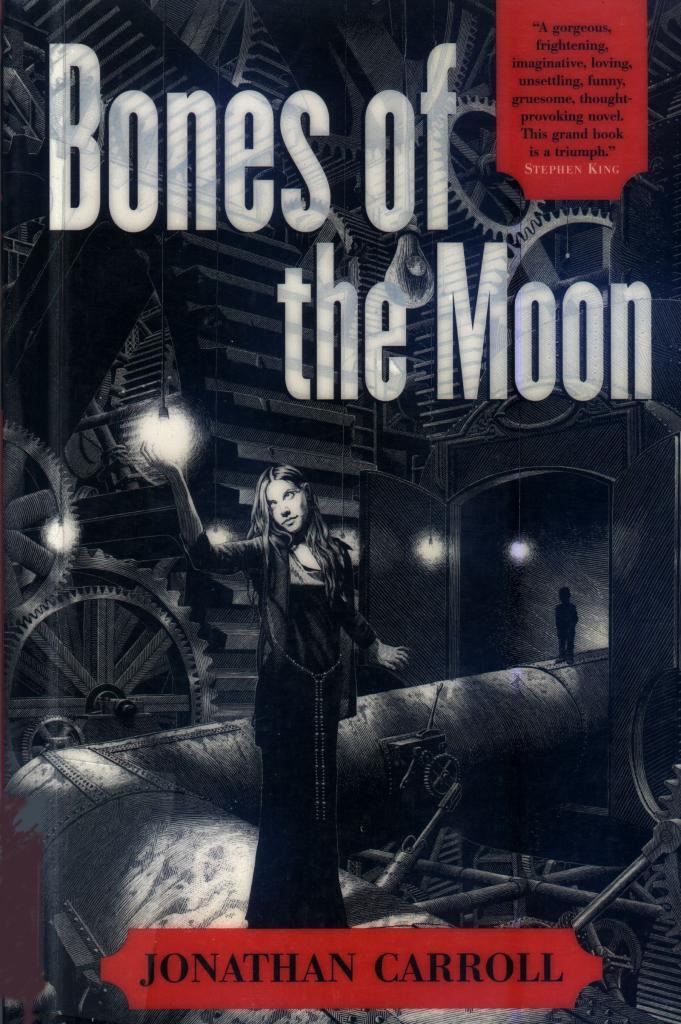
Jonathan Carroll: Bones of the Moon

Bones of the MoonLike most writers, I've woken up many times in the grip of a dream that seems like perfect material for a novel or a poem. Maybe you get as far as jotting it down before going back to sleep. When you wake up again, there's nothing there that makes sense. Dreams are fascinating to live through, but nonsense in daylight. Or, worse, they make too much sense - it's embarrassingly obvious what waking thoughts and experiences got translated into them. Either way they don't generally make good literature. And yet the urge to use them remains. Dreams are narratives, after all, and their very strangeness gives them the element of surprise we value in fiction. For writers who are fascinated by their own art (and what writer isn't?) they make a great metaphor for writing itself. They are used as a conventional framing device in,for example, Piers Plowman, The Divine Comedy, Alice. When we read them in this form, we're well aware of the conventions; the dream is not a real dream, and only retains those dreamlike characteristics that fit the writer's purpose.

In The Arabian Nightmare, Robert Irwin concentrates on two characteristics of dreams, the difficulty the sleeper sometimes has in telling sleep from waking, and the nesting of dreams within dreams. There is also a dreamlike strangeness due to the magical element that appears from time to time - but because of the blurring of sleep and waking, we never know if it's real or dream magic. Irwin's dreams are conventional - we are well aware that they are just another mode of storytelling. But there is one novel I know where the dreams are both an effective part of the narrative, and genuinely dreamlike.

Cullen James is a happily married woman living in New York with her husband and baby daughter. But there are a few shadows in her life. In the apartment downstairs, as we learn in the opening sentence of Bones of the Moon, a boy has gone crazy and killed his mother and sister with an axe. Before her marriage, Cullen herself had a series of unhappy relationships, culminating in an abortion about which she still has feelings of guilt. A charismatic but frightening film director is making insistent passes at her. And Cullen is suffering from her own version of the Arabian Nightmare, a series of intensely vivid dreams which connect together to form a continuous narrative:
How strange it was to eat glass and light. All of the food on the table was laid out beautifully and precisely. The spread would have looked delicious if everything wasn't transparent; splashing the light from the icy chandelier hung high and huge over the crystalline dining-table.
     Pepsi picked up his clear hot-dog wrapped in its clear bun and took a big bite. His walking stick leaned against the chair and was the only patch of colour around. Exposed to the sun for days on our walk here, the sticks had burned or ripened... changed from their original grey-brown to a deep, vivid purple.
     Sizzling Thumb had mine over his lap and kept petting it like a cat. 'Your tapes arrived without chicken.'
The dreams take the form of a quest through a magical land called Rondua. Cullen's companions are a number of talking animals, notably a hat-wearing dog called Mr Tracy, and a small boy, Pepsi, who is her son in the dreamworld (and, as we soon realize, a projection of her guilt about the abortion). They are searching for five magic tokens called the Bones of the Moon. And for all their surreal quality the dreams have a consistent structure: as they travel through the different regions of Rondua and collect the bones, the dream story moves towards its climax, a confrontation with the villainous Jack Chili. Meanwhile, Cullen's waking life is becoming more disturbed. The 'axe-boy', now in prison, has begun a worryingly obsessive correspondence with her. She seems to be developing supernatural powers; and the film director, Weber Gregston, starts having the same dreams.

Bones of the Moon is a brilliantly constructed fantasy thriller, though it teeters on the edge of sentimentality at times. But what really sets it apart is the portrayal of the dreams. Stephen King, an admirer of the book, has written: 'When has any novelist last caught so perfectly the weird but matter-of-fact experience of dreaming?' Never,as far as I know. These are the most dreamlike dreams I have ever seen in fiction, as absurd as they are compelling.

It's a nice piece of synchronicity that the author shares his surname with the author of the Alice books (though Lewis Carroll,of course,is a pen-name, while Jonathan is a Carroll by birth). He has written some fifteen novels, and all of those I've read show the same dazzling originality and imagination that characterize Bones of the Moon. Neil Gaiman, as well as King, is a fan. Carroll's first two novels, by the way, are published in the Fantasy Masterworks series, which I've mentioned before: I intend to blog about one of them at a later date.

Next time I'll be writing about an early, lesser-known novel by a major British post-war novelist.