Showing posts with label Historical Novel. Show all posts

Friday, 1 September 2017

Thinking Up Novels in the Bath

Mozart got his ideas while playing billiards, Lawrence Sterne while shaving.Luis Buñuel liked to sit on his own in a quiet bar sipping a dry martini. I seem to get mine in the bath. This is probably related to the fact that baths invariably send me to sleep, which is why I prefer showers on working days. On mornings when I have nothing pressing to do, I get in the bath, fall asleep, come round as the water becomes lukewarm and, lying there in a state somewhere between sleeping and waking, usually come up with another idea for a novel.

I have published two novels, twenty-five years apart and very different from each other. WHOM (1989) is a satirical romp about a womanizing US President who may or may not bring about an apocalyptic nuclear war by interfering in the politics of a fictitious Mediterranean island. Like so many first novels, it's a mish-mash of influences: Thomas Pynchon, Mikhail Bulgakov and Evelyn Waugh are the main ones I detect in it now. I still think it's quite funny - there's an extract from it here. The Book of the Needle (2014) is a more mature piece of work, a historical novel based on the story of the real-life 17th-century Welsh prophet and tailor Arise Evans; I researched it thoroughly and learned a lot about both history and fiction from the process, though I hoped, as with the earlier novel, to write something people would find funny and entertaining. Both novels could reasonably be said to have sunk without trace, and the process of writing a novel (two years for the first, four and a half for the second) is something I've found deeply disillusioning.

Yet I still dream of writing a novel. I read fiction constantly (whereas my poetry reading tends to be in bursts), and my love of narrative finds an outlet in many of my poems and poetic sequences. I have the poet's weakness of obsessing over phrases and details, and I find plots very difficult, which is why much of my recent work, in both poetry and fiction, has involved retelling existing stories. Otherwise, I think I have the makings of a novelist: I can write good prose and dialogue, invent characters, handle complex structures, and so on. The difficulty, as always, is to commit oneself to such a big project with no guarantee of finding a readership, or even a publisher, at the end of it. And the market has changed so much, and become so relentlessly commercial, over the past few years, that it seems harder than ever, especially for someone whose inclinations are towards the unfashionable modes of literary and (mildly) experimental fiction.

So I dream in the bath of a novel that I would enjoy enough to stick at it through all the uncertainties of the writing process, and might be able to sell at the end. Some of these ideas are old friends, which have surfaced many times before, only to be rejected for some difficulty or other, or because another one has come along which temporarily seems more exciting. Some are even things I have written already in a different genre, but which might be worth expanding into novel form. Some are obviously absurd, and yet, maybe with a little twist...

Here are some of them:

   An adaptation of my poetic sequence Mandeville, about the medieval traveller Sir John Mandeville.

   The autobiographical novel Starling City, about a breakdown I had in my early mid-twenties when I was living in 1980s Brighton. Perhaps combined with an old idea about a detective mystery in which the detective is a post-modernist who doesn't believe in truth.

   A historical novel about the early modern scientist Robert Hooke, about whom I have already written some poems.

   A novel based on the life of the food writer Elizabeth David, which I would fictionalize, combining her story with that of several other women of the time who had similarly adventurous lives.

   A historical thriller in which the protagonist is Christopher Marlowe, who narrates it in a voice borrowed from his namesake Philip Marlowe.

   A fantasy set in the world of pastoral in which everyone is either a shepherd or shepherdess, or pretends to be.

   A novel about the building of the great Welsh reservoirs.

   A novel based loosely on the life of W.S. Graham.

   A novel about a seventeenth-century astrologer and the cases he investigates.

   A ghost story with M.R.James as its protagonist.

   A alternative history novel in which the chess match between Fischer and Karpov, which was scheduled for 1975 but never took place, actually happens, in Cambridge where I was living at the time.

I think several of these ideas are plausible. But every time I contemplate putting in the work I remember my agent asking, of The Book of the Needle: "How are you going to sell this book?" And,not being able to think of an answer, I go back to writing poems, which I do at least have a publisher for.

Wednesday, 4 January 2012

William Tenn: Immodest Proposals / Here Comes Civilization

A smalltime businessman is sitting in his poky office when a man walks in without knocking and asks, "Would you be interested in buying a twenty for a five?" The newcomer is dirty and disreputable looking; the businessman tells him there are no beggars allowed in the building, and tries to throw him out. The newcomer wants to know what's wrong with his offer, but the businessman is unrelenting, so he retreats, leaving his card: he is Mr Ogo Eksar, operating out of a hotel in Times Square. The businessman, Bernie, can't get the incident out of his head. Obviously there's a catch, because no one in his right mind would offer to pay twenty dollars for a five-dollar bill. But Bernie's a bit of a hustler himself - he'd like to know what the catch is, and it can only cost him five dollars, at the worst, to find out. So he goes round to the hotel in Times Square, and they do the deal - the twenty and the five are exchanged and Eksar even insists on a receipt.

What happens now? Maybe Mr Eksar would be interested in another deal, say, buying a ten for a fifty, or a twenty for a hundred dollars?

Eksar is contemptuous. What kind of a deal is that?

Well, Bernie says, isn't there anything else you want to buy?

The Golden Gate Bridge.

This is the opening of William Tenn's short story 'Bernie the Faust'. In the course of a couple of pages, the two find themselves negotiating over other geographical features, like the Sea of Azov (It's only forty-nine feet deep! "Where are you going to do better than three hundred and eighty dollars for a sea like that?"), not to mention fishing and buried treasure rights on the moon. Bernie is slightly uneasy about the fact that he doesn't actually own any of these things, but Eksar is happy to agree to purchase only whatever rights Bernie may have to them, just so long as he gets his receipt. Of course, there is a catch, and Eksar is not what he seems. There are several twists before the end, but I won't spoil them for you.

I was probably about eleven when I first read that story. I was reading a lot of SF at the time, and other stories that made a deep impression on me were Isaac Asimov's 'I'm in Marsport Without Hilda', Damon Knight's 'The Country of the Kind', and Bob Shaw's 'Light of Other Days'. I read them for their inventiveness, and William Tenn consistently seemed to be the writer with the best ideas. I got a book of his stories, Time in Advance, out of the library: all of them were brilliant. I was on my way to becoming a fan.

Then - a refrain that will recur many times in this blog - I couldn't find anything more. All my friends were reading Asimov, nobody had heard of Tenn. In due course, my interest in SF cooled anyway (it has revived in the last few years), and I began to think I had imagined him, until one day about ten years ago I found 'Bernie the Faust' on the web, and it was as good as I remembered - better in fact, because I now understood how cleverly Tenn was manipulating the conventions of Jewish humour to make them into SF. It turned out he had a website, from which I learned that his real name was Philip Klass, and that his complete fiction had been published by NESFA Press, in two volumes (whose brilliant covers are shown here), called Immodest Proposals and Here Comes Civilization.

One reason for Tenn's comparative obscurity is that he was a short fiction specialist. The Golden Age of Science Fiction was dominated by magazines, in particular Astounding Science Fiction and Galaxy. That meant a big market for shorter forms, not just the short story proper, but the novelette (defined by the Nebula Awards as having a length of between 7,500 and 17,499 words, and the novella (between 17,500 and 40,000 words). There was a good living to be made writing these shorter forms, and they could subsequently be republished in anthologies and collections. But as the magazine market diminished, so too did the interest in short fiction, and writers like Tenn became marginalized. There is some hope the internet will eventually reverse this process - too late for Phil Klass, who died in 2010 at the age of 89, though from what I've read of him he was not the kind of man to feel any bitterness about it.

Of all the classic SF themes - post-apocalypse, androids, space travel, time travel, etc - it is aliens that Tenn excels in. In 'The Sickness', an arrogant intellectual on an international expedition to Mars is unnerved when all his companions are transformed by a virus into disembodied super-intelligences, like the Martians themselves. In 'Firewater' the aliens who have colonized Earth are so different from us that the only humans who manage to communicate with them go mad - though enriched by their contact with technological knowledge that is a valuable resource for any normal humans who are willing to trade with them. And in 'Venus and the Seven Sexes', he gives us an elaborately worked-out Venusian creature that has adapted to its hilariously hostile environment by evolving into seven distinct forms, creating a life-cycle so complicated it just manages to avoid extinction:
There is only one thing that all the ravening life-forms of Venus would rather eat than each other, and that one thing is a Plookh.
There's a joyous extravagance in his exploration of the idea of alienness and the juxtaposition of incompatible values it implies: they may be bug-eyed monsters to us, but we, to use a term from one of his stories, are flat-eyed monsters to them. This relativism puts him in a great satirical tradition which, as the title Immodest Proposals suggests, he was well aware of. It's also, of course, a natural theme for a New York Jew, aware not only of a heritage of obscure and wonderful knowledge, but also of the daunting fact that many of the other groups around you would rather devour you than each other.

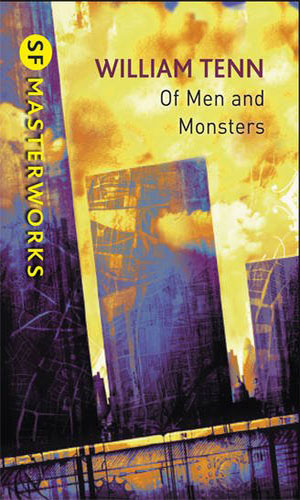
If you don't fancy buying the complete works, his only novel, Of Men and Monsters, is available in the superb SF Masterworks Series. (It is also included in Here Comes Civilization, and illustrated on the cover to that book, shown above):
Mankind consisted of 128 people.

The sheer population pressure of so vast a horde had long ago filled over a dozen burrows. Bands of the Male Society patrolled the outermost corridors with their full strength, twenty-three young adult males in the prime of courage and alertness. They were stationed there to take the first shock of any danger to Mankind, they and their band captains and the youthful initiates who served them.

Eric the Only was an initiate in this powerful force.
Giant aliens have invaded Earth and taken over all our resources. Nothing like a war can be said to have taken place: the aliens are too huge and advanced even to recognize us as intelligent. Human beings are reduced to living, mouselike, in burrows in the walls of alien houses. (Some editions of the novel carry the alternative title The Men in the Walls.) This is Tenn at his most Swiftian, ruthless in the accuracy of his satire. Like the mating cycle of the Venusian Plookh, the anthropology of his parasitic Mankind is worked out with a rigour that probably owes something to the influence of his scientist brother, Morton. It's a very funny, but sometimes dark, book, and makes a great introduction to Tenn's work.

It's about time I did an entry on a living author, so next time I will be blogging about the first novel of an eminent British scholar of Arabic literature, a fabulation set in medieval Cairo.

Monday, 19 December 2011

H.F.M. Prescott: The Man on a Donkey


In my last posting, I mentioned my teenage addiction to Penguin Modern Classics. They're one of a handful of imprints over the years that have seemed to me to guarantee excitement, even before I know anything else about the book. After it came those wonderful revolving stands of Picador books round about 1980, and more recently the Gollancz SF Masterworks and Fantasy Masterworks books. I don't know how I found myself reading The Man on a Donkey when I was about fourteen, whether it was a present or I bought it myself. I certainly knew nothing about it beforehand except that it was a Modern Classic - and it must have been about the most obscure book ever published in that series, because I have hardly heard anything about it since. At the time I thought it was one of the best books I'd ever read; I still have that battered edition (the one illustrated here), and have occasionally toyed with the idea of rereading it. Finally I got round to it a few months ago, some forty years after I first read it, largely because I had recently finished writing a historical novel and was about to start another one, and I wanted to look at other examples of the genre. Would it be as good as I remembered, or would it be basically a cheap romance with historical trappings?

The Man on a Donkey was first published in 1952. The author, Hilda Frances Margaret Prescott, was a historian, author of a biography of Mary Tudor, as well as several other novels, none of which I have read. There can be little doubt, though, that this is her masterpiece. Nearly 800 pages long, it tells the story of The Pilgrimage of Grace, one of Britain's more obscure revolutions, a popular uprising in the North of England against Henry VIII's religious reforms, in particular the Dissolution of the Monasteries. The Pilgrimage, as its name suggests, was not a very warlike uprising: there were no battles, and the Pilgrims all packed up and went home on receiving assurances of mercy from the King - assurances which he went back on as soon as the danger had passed. In one sense, then, a non-event; but a non-event which was a reaction to one of the greatest and most far-reaching changes in history.

Prescott starts her narrative long before the Pilgrimage itself. Her approach is to write a chronicle of daily life, with entries for particular dates and, often, long gaps in between, especially near the beginning. Only gradually do we become aware of a story developing; even the five main characters are introduced one at a time. We begin with Christabel Cowper, a merchant's daughter who is going to rise to become Prioress of Marrick in the Yorkshire Dales. We see her as a child, travelling to the Priory for the first time, then, through the entries of the chronicle, we see the various stages in her development as she grows in maturity and power. We get from 1509 to 1520 before a scene in which someone mentions another character who is to become important, Thomas, Lord Darcy, and at this point Prescott breaks the chronicle pattern to give us an introduction to him. When the Chronicle resumes, there are two main threads to follow, until a new major character is first glimpsed, then introduced (they will fade out in the same way, in the order in which they entered).

After Christabel and Darcy, an elderly courtier of conservative temperament, we meet Robert Aske, the leader of the Pilgimage, Julian Savage, a young girl who is in love with him, and Gilbert Dawe, a poor priest who becomes a a Protestant while this is still regarded as a dangerous heresy. Aske and Darcy are historical figures, Christabel Cowper was the name of the real Prioress of Marrick but nothing much is known of her, while Julian and Gilbert are fictitious. Another important character is Malle, the simple-minded serving woman at Marrick, whose vision of Christ in the scene that gives the novel its title is a critical event in the other characters' lives.

It is hard to imagine a slower-moving novel, or, as far as I'm concerned, a more mesmerizing one. Many of the incidents that receive coverage in the chronicle are tiny, and there are hundreds of them. Any modern editor, surely, would cut about four hundred pages - and leave the novel far less rich and complex as a result. We read historical fiction not just to get a story, but to know what life must have been like for people in a remote time. I can't think of another novel (or history book either, come to that) that offers anything like the depth and vividness of historical detail we find here. Much of this, of course, is due to the scholarship of a trained historian but a great deal must be put down to the power of her imagination:
Those two of Queen Katherine's ladies whose duty it was today to fetch food for the Queen's breakfast met again near the door of the Pastry. Both had pink noses and blue fingers, for the air was sharp, and the perpetual winter chill of the waterlogged country all round made it colder still in the late dawn. One of the two had been waiting for the milking; watching from the door of the dark shippen, where the lanterns cast huge shadows, and caught here the cross beams of the roof, there the wide shining eye of a cow, and there the thin steam of its breath, puffing, spreading and fainting from sight. Now she brought again the pitcher full of the warm, frothed milk, and found the other waiting, stamping her feet, with a white loaf and some eggs in a basket, and on top of the eggs a fish.
This passage gives a good idea of her prose; she's not afraid of adjectives, though the ones she uses here are all sensuous ones that add to the vividness of the scene: sharp, shining, thin etc. She expects you to be able to deal with words like shippen, and Pastry used to mean a building rather than a foodstuff; she rejects the standard historical novelist's approach of using a neutral language to avoid frightening the reader with archaic words - her preference throughout is for historically accurate diction if she can possibly justify it. There is also a music in some of her sentence construction that seems to echo, not just the King James Bible, but still older sources, such as the mystic Julian of Norwich, who is referred to in the book and after whom her character Julian is named. The two ladies in this scene are getting the Queen's breakfast: their job is a tense one because it would suit the King's purposes to have his ex-wife out of the way for good, so they have to be absolutely sure his agents have no way of poisoning her food. Neither the ladies nor the Queen are really important in the story, and soon the Queen will be dead in any case. (The novel hints that she really was poisoned.) In the same way, we get glimpses of Cardinal Wolsey's decline, Anne Boleyn's transition from triumphant seductress to terrified prisoner, Thomas Cromwell's rise to power and numerous other big themes, all interwoven by the chronicle structure with the daily life of the five main characters.

One of Prescott's greatest achievements, and the one that dominates the first two-thirds of the book, is to give us what must surely be the most complete picture in fiction of life in an early modern religious order. The Priory is a landed estate, a working farm and a largish business; the Ladies (as the nuns are always called) who run it have the only equivalent to a modern career open to most women of the time. They are important people in the area, treated as equals by the local aristocracy, and as superiors by everyone else. It is a terrible moment in Julian Savage's life when she is forbidden to join them. At the same time, of course, their lives are strictly circumscribed. Young Christabel's adolescent flirtation with a boy of her own age comes to an abrupt end, and she is happy to to immerse all her energies thereafter in the pursuit and exercise of power. She is probably the most memorable character in the book, a ruthless, intelligent woman who has the courage to take on Cromwell face to face, and almost wins.

When the story of the Pilgrimage finally gets going, the narrative, surprisingly, seems to lose some of its grip. I recognize this syndrome from my own attempts to write about history. Up to now, Prescott has focused on everyday life and imagined incidents: now she is tied to the historical record, and what actually happened doesn't always make good fiction. We get a lot about the comings and goings of Aske at the beginning of the Pilgrimage, moving between Lincolnshire and Yorkshire. It's not at all clear how far he was in charge of events and how far he was coerced into his involvement by the threats of the insurgents. The Pilgrimage itself doesn't really provide the climax of the book: what does reach a climax is the treachery and viciousness of Henry VIII, who, as portrayed here, was a tyrant to rank with the worst of our own age. Aske, the nearest Prescott comes to the dashing hero-figure of more popular historical fiction, is hideously executed, as each of the narrative threads in turn reaches its conclusion. Above all, the monasteries are finished, and a way of life which was never portrayed romantically but which we have come through Prescott's sympathetic portrayal almost to love, has gone for ever.

The Man on a Donkey, in my opinion, is one of the greatest British novels of the twentieth century. Quite why it has been so underrated is a mystery. It's a big, dense, intellectually demanding book, but those qualities didn't, in the long run, do Ulysses any harm. Why haven't the feminist critics and publishers who have done so much to revive the reputations of forgotten women authors taken Prescott to their hearts? I suspect it has something to do with her religious convictions. Prescott was a contemporary of Anglican intellectuals like T.S. Eliot and C.S. Lewis, and Roman Catholic ones like Evelyn Waugh, Graham Greene and Muriel Spark; an Anglican herself, she was undoubtedly attracted by the poetic and mystical elements in Catholicism. The Catholics are, to put it crudely, the good guys in her account, and there is arguably a conservatism in her view of history that could be extrapolated into a suspicion of new intellectual developments in general. Whether or not this is true, there is no getting away from the fact that this is an explicitly religious work. Malle's vision of Christ is, more or less literally, central to it. In a series of scenes around the middle of the book each of the main characters in turn interrogates Malle about what she has seen and to each she replies in the same words: "There was a great wind of light blowing, and sore pain."

Whatever this reply means (and each character responds to it in a different, but equally puzzled and unsatisfied, way), it is not a piece of pious moralizing. Christ may be here among us, it seems to say, but we have no way of knowing what to do about it, and any answer we can come up with is likely to make his suffering - and our own - even worse. Prescott's vision may be Christian, but it is also uncompromisingly Modernist in its fragmentation and difficulty. Besides, she is too much of an artist to be satisfied with a simple schematic representation of right and wrong. Christabel, the representative of the old religious way of life, is an intensely materialistic woman (yet somehow never loses our sympathy), while Gib Dawe, the new-style Protestant, has a deep yearning for religious truth (but is doomed by his own nature never to find it). She writes equally sensitively, equally dispassionately, of both.

I am pleased to say that The Man on a Donkey is still in print, in a two-volume edition from Loyola Press. Judging by what I have been able to find on the Internet, it retains its popularity among two groups in particular, Christian readers and connoisseurs of the historical novel. Speaking as someone who does not fit into either category, I believe it deserves a much wider readership. I have selected it as my first title for White Threshold because I see it as a classic case of the kind of fiction this blog is about, a novel whose limited reputation comes nowhere near matching its literary significance. For that reason, I have written a longer entry than I expect to write for most of the later books in this series.

In general I won't be announcing the subjects of the blog in advance, but my next entry will be a tribute to the late Russell Hoban, and his masterpiece Riddley Walker.