Showing posts with label Satire. Show all posts

Friday, 1 September 2017

Thinking Up Novels in the Bath

Mozart got his ideas while playing billiards, Lawrence Sterne while shaving.Luis Buñuel liked to sit on his own in a quiet bar sipping a dry martini. I seem to get mine in the bath. This is probably related to the fact that baths invariably send me to sleep, which is why I prefer showers on working days. On mornings when I have nothing pressing to do, I get in the bath, fall asleep, come round as the water becomes lukewarm and, lying there in a state somewhere between sleeping and waking, usually come up with another idea for a novel.

I have published two novels, twenty-five years apart and very different from each other. WHOM (1989) is a satirical romp about a womanizing US President who may or may not bring about an apocalyptic nuclear war by interfering in the politics of a fictitious Mediterranean island. Like so many first novels, it's a mish-mash of influences: Thomas Pynchon, Mikhail Bulgakov and Evelyn Waugh are the main ones I detect in it now. I still think it's quite funny - there's an extract from it here. The Book of the Needle (2014) is a more mature piece of work, a historical novel based on the story of the real-life 17th-century Welsh prophet and tailor Arise Evans; I researched it thoroughly and learned a lot about both history and fiction from the process, though I hoped, as with the earlier novel, to write something people would find funny and entertaining. Both novels could reasonably be said to have sunk without trace, and the process of writing a novel (two years for the first, four and a half for the second) is something I've found deeply disillusioning.

Yet I still dream of writing a novel. I read fiction constantly (whereas my poetry reading tends to be in bursts), and my love of narrative finds an outlet in many of my poems and poetic sequences. I have the poet's weakness of obsessing over phrases and details, and I find plots very difficult, which is why much of my recent work, in both poetry and fiction, has involved retelling existing stories. Otherwise, I think I have the makings of a novelist: I can write good prose and dialogue, invent characters, handle complex structures, and so on. The difficulty, as always, is to commit oneself to such a big project with no guarantee of finding a readership, or even a publisher, at the end of it. And the market has changed so much, and become so relentlessly commercial, over the past few years, that it seems harder than ever, especially for someone whose inclinations are towards the unfashionable modes of literary and (mildly) experimental fiction.

So I dream in the bath of a novel that I would enjoy enough to stick at it through all the uncertainties of the writing process, and might be able to sell at the end. Some of these ideas are old friends, which have surfaced many times before, only to be rejected for some difficulty or other, or because another one has come along which temporarily seems more exciting. Some are even things I have written already in a different genre, but which might be worth expanding into novel form. Some are obviously absurd, and yet, maybe with a little twist...

Here are some of them:

   An adaptation of my poetic sequence Mandeville, about the medieval traveller Sir John Mandeville.

   The autobiographical novel Starling City, about a breakdown I had in my early mid-twenties when I was living in 1980s Brighton. Perhaps combined with an old idea about a detective mystery in which the detective is a post-modernist who doesn't believe in truth.

   A historical novel about the early modern scientist Robert Hooke, about whom I have already written some poems.

   A novel based on the life of the food writer Elizabeth David, which I would fictionalize, combining her story with that of several other women of the time who had similarly adventurous lives.

   A historical thriller in which the protagonist is Christopher Marlowe, who narrates it in a voice borrowed from his namesake Philip Marlowe.

   A fantasy set in the world of pastoral in which everyone is either a shepherd or shepherdess, or pretends to be.

   A novel about the building of the great Welsh reservoirs.

   A novel based loosely on the life of W.S. Graham.

   A novel about a seventeenth-century astrologer and the cases he investigates.

   A ghost story with M.R.James as its protagonist.

   A alternative history novel in which the chess match between Fischer and Karpov, which was scheduled for 1975 but never took place, actually happens, in Cambridge where I was living at the time.

I think several of these ideas are plausible. But every time I contemplate putting in the work I remember my agent asking, of The Book of the Needle: "How are you going to sell this book?" And,not being able to think of an answer, I go back to writing poems, which I do at least have a publisher for.

Wednesday, 4 January 2012

William Tenn: Immodest Proposals / Here Comes Civilization

A smalltime businessman is sitting in his poky office when a man walks in without knocking and asks, "Would you be interested in buying a twenty for a five?" The newcomer is dirty and disreputable looking; the businessman tells him there are no beggars allowed in the building, and tries to throw him out. The newcomer wants to know what's wrong with his offer, but the businessman is unrelenting, so he retreats, leaving his card: he is Mr Ogo Eksar, operating out of a hotel in Times Square. The businessman, Bernie, can't get the incident out of his head. Obviously there's a catch, because no one in his right mind would offer to pay twenty dollars for a five-dollar bill. But Bernie's a bit of a hustler himself - he'd like to know what the catch is, and it can only cost him five dollars, at the worst, to find out. So he goes round to the hotel in Times Square, and they do the deal - the twenty and the five are exchanged and Eksar even insists on a receipt.

What happens now? Maybe Mr Eksar would be interested in another deal, say, buying a ten for a fifty, or a twenty for a hundred dollars?

Eksar is contemptuous. What kind of a deal is that?

Well, Bernie says, isn't there anything else you want to buy?

The Golden Gate Bridge.

This is the opening of William Tenn's short story 'Bernie the Faust'. In the course of a couple of pages, the two find themselves negotiating over other geographical features, like the Sea of Azov (It's only forty-nine feet deep! "Where are you going to do better than three hundred and eighty dollars for a sea like that?"), not to mention fishing and buried treasure rights on the moon. Bernie is slightly uneasy about the fact that he doesn't actually own any of these things, but Eksar is happy to agree to purchase only whatever rights Bernie may have to them, just so long as he gets his receipt. Of course, there is a catch, and Eksar is not what he seems. There are several twists before the end, but I won't spoil them for you.

I was probably about eleven when I first read that story. I was reading a lot of SF at the time, and other stories that made a deep impression on me were Isaac Asimov's 'I'm in Marsport Without Hilda', Damon Knight's 'The Country of the Kind', and Bob Shaw's 'Light of Other Days'. I read them for their inventiveness, and William Tenn consistently seemed to be the writer with the best ideas. I got a book of his stories, Time in Advance, out of the library: all of them were brilliant. I was on my way to becoming a fan.

Then - a refrain that will recur many times in this blog - I couldn't find anything more. All my friends were reading Asimov, nobody had heard of Tenn. In due course, my interest in SF cooled anyway (it has revived in the last few years), and I began to think I had imagined him, until one day about ten years ago I found 'Bernie the Faust' on the web, and it was as good as I remembered - better in fact, because I now understood how cleverly Tenn was manipulating the conventions of Jewish humour to make them into SF. It turned out he had a website, from which I learned that his real name was Philip Klass, and that his complete fiction had been published by NESFA Press, in two volumes (whose brilliant covers are shown here), called Immodest Proposals and Here Comes Civilization.

One reason for Tenn's comparative obscurity is that he was a short fiction specialist. The Golden Age of Science Fiction was dominated by magazines, in particular Astounding Science Fiction and Galaxy. That meant a big market for shorter forms, not just the short story proper, but the novelette (defined by the Nebula Awards as having a length of between 7,500 and 17,499 words, and the novella (between 17,500 and 40,000 words). There was a good living to be made writing these shorter forms, and they could subsequently be republished in anthologies and collections. But as the magazine market diminished, so too did the interest in short fiction, and writers like Tenn became marginalized. There is some hope the internet will eventually reverse this process - too late for Phil Klass, who died in 2010 at the age of 89, though from what I've read of him he was not the kind of man to feel any bitterness about it.

Of all the classic SF themes - post-apocalypse, androids, space travel, time travel, etc - it is aliens that Tenn excels in. In 'The Sickness', an arrogant intellectual on an international expedition to Mars is unnerved when all his companions are transformed by a virus into disembodied super-intelligences, like the Martians themselves. In 'Firewater' the aliens who have colonized Earth are so different from us that the only humans who manage to communicate with them go mad - though enriched by their contact with technological knowledge that is a valuable resource for any normal humans who are willing to trade with them. And in 'Venus and the Seven Sexes', he gives us an elaborately worked-out Venusian creature that has adapted to its hilariously hostile environment by evolving into seven distinct forms, creating a life-cycle so complicated it just manages to avoid extinction:
There is only one thing that all the ravening life-forms of Venus would rather eat than each other, and that one thing is a Plookh.
There's a joyous extravagance in his exploration of the idea of alienness and the juxtaposition of incompatible values it implies: they may be bug-eyed monsters to us, but we, to use a term from one of his stories, are flat-eyed monsters to them. This relativism puts him in a great satirical tradition which, as the title Immodest Proposals suggests, he was well aware of. It's also, of course, a natural theme for a New York Jew, aware not only of a heritage of obscure and wonderful knowledge, but also of the daunting fact that many of the other groups around you would rather devour you than each other.

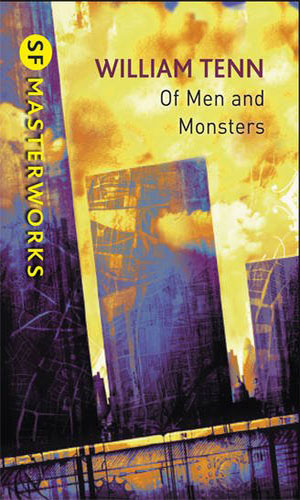
If you don't fancy buying the complete works, his only novel, Of Men and Monsters, is available in the superb SF Masterworks Series. (It is also included in Here Comes Civilization, and illustrated on the cover to that book, shown above):
Mankind consisted of 128 people.

The sheer population pressure of so vast a horde had long ago filled over a dozen burrows. Bands of the Male Society patrolled the outermost corridors with their full strength, twenty-three young adult males in the prime of courage and alertness. They were stationed there to take the first shock of any danger to Mankind, they and their band captains and the youthful initiates who served them.

Eric the Only was an initiate in this powerful force.
Giant aliens have invaded Earth and taken over all our resources. Nothing like a war can be said to have taken place: the aliens are too huge and advanced even to recognize us as intelligent. Human beings are reduced to living, mouselike, in burrows in the walls of alien houses. (Some editions of the novel carry the alternative title The Men in the Walls.) This is Tenn at his most Swiftian, ruthless in the accuracy of his satire. Like the mating cycle of the Venusian Plookh, the anthropology of his parasitic Mankind is worked out with a rigour that probably owes something to the influence of his scientist brother, Morton. It's a very funny, but sometimes dark, book, and makes a great introduction to Tenn's work.

It's about time I did an entry on a living author, so next time I will be blogging about the first novel of an eminent British scholar of Arabic literature, a fabulation set in medieval Cairo.