Friday, 1 September 2017

Thinking Up Novels in the Bath

Mozart got his ideas while playing billiards, Lawrence Sterne while shaving.Luis Buñuel liked to sit on his own in a quiet bar sipping a dry martini. I seem to get mine in the bath. This is probably related to the fact that baths invariably send me to sleep, which is why I prefer showers on working days. On mornings when I have nothing pressing to do, I get in the bath, fall asleep, come round as the water becomes lukewarm and, lying there in a state somewhere between sleeping and waking, usually come up with another idea for a novel.

I have published two novels, twenty-five years apart and very different from each other. WHOM (1989) is a satirical romp about a womanizing US President who may or may not bring about an apocalyptic nuclear war by interfering in the politics of a fictitious Mediterranean island. Like so many first novels, it's a mish-mash of influences: Thomas Pynchon, Mikhail Bulgakov and Evelyn Waugh are the main ones I detect in it now. I still think it's quite funny - there's an extract from it here. The Book of the Needle (2014) is a more mature piece of work, a historical novel based on the story of the real-life 17th-century Welsh prophet and tailor Arise Evans; I researched it thoroughly and learned a lot about both history and fiction from the process, though I hoped, as with the earlier novel, to write something people would find funny and entertaining. Both novels could reasonably be said to have sunk without trace, and the process of writing a novel (two years for the first, four and a half for the second) is something I've found deeply disillusioning.

Yet I still dream of writing a novel. I read fiction constantly (whereas my poetry reading tends to be in bursts), and my love of narrative finds an outlet in many of my poems and poetic sequences. I have the poet's weakness of obsessing over phrases and details, and I find plots very difficult, which is why much of my recent work, in both poetry and fiction, has involved retelling existing stories. Otherwise, I think I have the makings of a novelist: I can write good prose and dialogue, invent characters, handle complex structures, and so on. The difficulty, as always, is to commit oneself to such a big project with no guarantee of finding a readership, or even a publisher, at the end of it. And the market has changed so much, and become so relentlessly commercial, over the past few years, that it seems harder than ever, especially for someone whose inclinations are towards the unfashionable modes of literary and (mildly) experimental fiction.

So I dream in the bath of a novel that I would enjoy enough to stick at it through all the uncertainties of the writing process, and might be able to sell at the end. Some of these ideas are old friends, which have surfaced many times before, only to be rejected for some difficulty or other, or because another one has come along which temporarily seems more exciting. Some are even things I have written already in a different genre, but which might be worth expanding into novel form. Some are obviously absurd, and yet, maybe with a little twist...

Here are some of them:

   An adaptation of my poetic sequence Mandeville, about the medieval traveller Sir John Mandeville.

   The autobiographical novel Starling City, about a breakdown I had in my early mid-twenties when I was living in 1980s Brighton. Perhaps combined with an old idea about a detective mystery in which the detective is a post-modernist who doesn't believe in truth.

   A historical novel about the early modern scientist Robert Hooke, about whom I have already written some poems.

   A novel based on the life of the food writer Elizabeth David, which I would fictionalize, combining her story with that of several other women of the time who had similarly adventurous lives.

   A historical thriller in which the protagonist is Christopher Marlowe, who narrates it in a voice borrowed from his namesake Philip Marlowe.

   A fantasy set in the world of pastoral in which everyone is either a shepherd or shepherdess, or pretends to be.

   A novel about the building of the great Welsh reservoirs.

   A novel based loosely on the life of W.S. Graham.

   A novel about a seventeenth-century astrologer and the cases he investigates.

   A ghost story with M.R.James as its protagonist.

   A alternative history novel in which the chess match between Fischer and Karpov, which was scheduled for 1975 but never took place, actually happens, in Cambridge where I was living at the time.

I think several of these ideas are plausible. But every time I contemplate putting in the work I remember my agent asking, of The Book of the Needle: "How are you going to sell this book?" And,not being able to think of an answer, I go back to writing poems, which I do at least have a publisher for.

Sunday, 27 August 2017

August Blues / Wheel of Books

Every year I get the August blues. August is the time when I have most freedom, and I always hope to use that to get some writing done. Instead, a state of lethargy sets in, which gradually begins to dissolve as autumn approaches, with dark evenings, a bit of chill in the air and the prospect of another university term. That hasn't quite happened yet. It's plum season; the sweet-sharp taste of plums is something I associate with guilty and melancholy feelings at the thought of another summer I haven't done quite enough with.

As a matter of fact I finished a new collection of poems at the beginning of the month, so things haven't been as bad as all that - it's just that I haven't been able to get going properly on the projects that ought to come next. To cheer myself up, I am posting this wheel of books: the ten I have published in the course of my life, together with the manuscript of what I hope will be number eleven. The ten are as follows:

   WHOM, novel, published by Bloomsbury in 1989.

   Blizzard, poems, Faber and Faber, 1996.

   Dragons, poems, Faber, 2001.

   Where the People Are: Language and Community in the Poetry of W.S. Graham, critical book, Salt, 2004.

   Whereabouts, poems, rufus books, 2005.

   Mandeville, poems, Faber, 2008.

   Singing a Man to Death, short stories, Cinnamon, 2012.

   Muscovy, poems, Faber, 2013.

   The Book of the Needle, novel, Cinnamon, 2014.

   The Mabinogi, poems, Faber, 2017.

The eleventh book is called Wing (I have a fondness for one-word titles, as the above suggests), and I plan to send it to my editor at Faber on 1 September, after which I will have an anxious wait to see if it's accepted.

Meanwhile, I have reopened this blog, White Threshold. This has its origins in another idle spell, in late 2011, when I was just coming to the end of a period of research leave and wanted something to do to fill up the remaining time. I started a blovel or blog novel, called Starling City, with no great hope that it would come to anything, as indeed it didn't. The blog remains online in its unfinished state, and I doubt if it will ever be reopened as a blovel, though the novel idea may be worth returning to. (My struggles with the novel form are a topic for another post, as is my tendency to return to old ideas years later.) White Threshold, the companion blog of Starling City, named after a collection of poems by W.S. Graham, was planned as a series of reviews of fiction I considered to be underrated. You can still find those reviews here; I am pleased with them and would like to think they may attract some new readers to extraordinary writers like H.F.M. Prescott, Jerome Charyn and Richard Beard. But that project, too, fizzled out. The reviews were hard work, since I usually had to reread the books before writing about them, and I just didn't have the time to keep the blog going.

Now, though, I have become aware that my online presence is a bit patchy. I have a website, which I update very occasionally, and am on Facebook and Twitter. Sometimes I want to share things that are too lengthy and detailed for the social media sites and too ephemeral for my own site. And writers nowadays are expected to blog. In fact, for the last few years, I have taught a seminar on blogging to new doctoral students at Aberystwyth University, where I work, and have had to explain to people who usually know more about the subject than I do that I don't blog myself. Hence my belated reopening of White Threshold as a blog for anything I feel like writing about. Possible subjects are:

   My own writing;

   The contemporary literary scene, especially poetry and especially in Wales;

   Creative writing and the problems of teaching it

   Chess (I am the chair of Aberystwyth Chess Club);

   The ukulele, which I took up a couple of years ago, having been abnormally ungifted at music all my life, and which now gives me immense pleasure;

   Walking, and the beautiful Welsh countryside;

   Cooking;

   Badminton;

... and so on. I have come late to this kind of thing, because I have had a lifelong aversion to keeping a diary. (I am particularly indignant about the creative writing manuals which insist on it as prerequisite for other kinds of writing.) My attitude has always been that of T.S. Eliot, who described poetry as "not the expression of personality but an escape from personality". But most of the literary world is against me here, as is most of the online world. And the fact is that I have a lot of things I want to write about that I am not getting the chance to communicate. At any rate, it may help to keep the August blues at bay.

Saturday, 12 July 2014

Compton Mackenzie: Carnival

Jenny Pearl, born Jenny Raeburn, is a dancer on the stage. She is beautiful and talented, but otherwise a rather ordinary girl, sharp-tongued, unsentimental but far from insensitive in her relations with men, fond of, but often at odds with, her unartistic family. Her problem ultimately is the discrepancy between her gifts of beauty and grace, and her impoverished cockney background and all that goes with it. Like a chorus-girl in a P.G. Wodehouse story, Jenny has no shortage of suitors from a different social class. Realistic as she is, she nevertheless falls hard for one of them. Like her, Maurice Avery is separated from his natural milieu by artistic interests; he is playing at the bohemian life with his intellectual friends. For a while, this provides enough common ground for a relationship, though one that she won't allow to lead to sex and he won't allow to lead to marriage. It will end badly; Maurice is too weak a character to flout convention for long, and when he lets her down, Jenny makes the most disastrous decision of her life. She marries another suitor, the sinister religious bigot Zachary Trewhella, and goes to live with him in his farm in Cornwall: a beautiful place, beautifully evoked in Mackenzie's rich prose, but one which provides the backdrop for a final tragedy.

I was led to Carnival by my enjoyment of another Compton Mackenzie novel, The Monarch of the Glen. You may remember the BBC series, part comedy, part soap opera, which was quite enjoyable until the Richard Briers character got killed off. The novel is completely different, set in the 1930s and depicting the struggles of a hidebound Scottish laird against the forces of modernity: hikers in shorts, rich Americans and left-wing poets. In fact, one of the few things I knew about Mackenzie is that he was active in Scottish Nationalist politics and had a bitter feud with that greatest of Scottish left-wing poets, Hugh MacDiarmid. Another thing I knew about him was that his novel Whisky Galore was the basis of an Ealing comedy film; that was the next book of his I read, finding it slightly disappointing after the very funny Monarch. Then came Carnival, which was a big surprise in all sorts of ways.

For a start, where was the Scottishness? I'd pictured Mackenzie as a Highland laird like his own Hector MacDonald. Here, on the other hand, was a novel steeped in London life, above all working-class Islington and the West End. It turns out that, like so many nationalists, he was only tenuously connected to the place he was nationalist about, having been born in Durham to a theatrical family and educated in London and Oxford. There's a density and realism to his depiction of London that's far more impressive than the Celtic trappings of the later novels. His ear for dialogue, above all, is wonderful. Jenny has a little clutch of catchphrases that include 'Oh no, it's only a rumour!' (sarcastically, to imply that she sees through an obvious attempt to deceive), 'you date!' (a soppy man - 'soppy' is another favourite word), 'he'll spring it on you' (seduce you) and 'thanks for those few nuts' (rebuffing a compliment), as well as the more obvious 'Oo-er! and 'Hark at him!'

There's also, despite the liveliness and unsentimentality of the dialogue, an intensity, seriousness and ambition that are quite unexpected. This is a long and detailed novel that starts right at the beginning with a chapter describing Jenny's birth, then takes us all through her childhood before getting on to her theatrical career. Mackenzie is undaunted by the challenge of writing about a character of a different gender and class; telling us about other people's lives is his business and he is very, very good at it. At the same time, we never lose sight of the difference between the language and sensibility of the narrator and his presumed readers and those of the heroine and her family. The mismatch between the two, flowery description and dispassionate analysis on the one hand, earthy characters and dialogue on the other, is fundamental to his writing:

Jenny lay awake in a fury that night. One after another, man in his various types passed across the screen of her mind. She saw them all. The crimson-jointed, fishy-eyed Glasgow youths winked at her once more. The complacent subalterns of Dublin dangled their presents and waited to be given her thanks and kisses. Old men, from the recess of childish memories, rose up again and leered at her. Her own father, small and weak and contemptible, pottered across the line of her mental vision. Bert Harding was there, his black boot-button eyes glittering from a crowd of dirty rotters. And to that her sister had surrendered herself, to be pawed and mauled about and boasted of. Ugh! Suddenly in the middle of her disgust Jenny thought she heard a sound under the bed.
  'Oo-er, May!' she called out, 'May!'
  'Whatever is it, you noisy thing?'
  'Oo-er, there's a man under the bed! Oh, May, wake up, else we shall be murdered!'
  'Whatever next?' said May. 'Go to sleep.'
  And just then the Raeburns' big cat, tired of his mouse-hole, came out from underneath the bed and walked slowly across the room.

The result is mock-heroic, or, in the central metaphor of the book, a Commedia dell' Arte perfomance with Jenny as Columbine and Maurice as Harlequin.

Carnival was published in 1912. For us, that's the age of Conrad and Lawrence (another of my few snippets of prior knowledge about Mackenzie was that he was lampooned in Lawrence's short story 'The Man Who Loved Islands'); in the next few years the novel would be shaken even more profoundly by Joyce and Woolf, Hemingway and Faulkner. Like most of his literary contemporaries, he was travelling a different route, one that now seems to us a dead-end. I'm sure if you had asked this brilliant young writer whose work he was modelling himself on, he would have said Dickens. (The same answer would have been given by Patrick Hamilton, another writer I've dealt with in this blog.) There's the London setting, the wide canvas, the epic scale, the range of tone from comic to tragic. And the twentieth century, in hindsight, was not the right era for the Dickensian novel. He must have realized it himself, turning in later life to those less ambitious books he is remembered for. (He also wrote a sequel to Carnival called Coral, which is worth reading, but not in the same class.) Still, the book works: a little overwritten in places, it is nevertheless rich, involving, and a tour de force of fictional realism. It doesn't deserve to be forgotten.

Next time, the mostly spooky short stories of a Georgian poet whose fiction has been unjustly neglected.

Sunday, 4 May 2014

Richard Beard: Damascus

It is the first of November 1993, a significant date in Britain's history: we have just become part of the European Union. On this day, in a trope reminiscent of Salman Rushdie's Midnight's Children, a boy and a girl are born to rather different but not untypical families. We are to follow their lives as they grow up, meet, drift apart and eventually become lovers. It's a state-of-the-nation novel, then, but if that genre suggests a tiresome earnestness, let me assure you that Beard's interpretation of it is every bit as unexpected as Rushdie's.

For a start, where is all this happening?

It is the first of November 1993 and somewhere in the Kingdom, in Quarndon or Northampton or Newry or York, in Kircaldy or Yeovil or Lincoln or Neath, a baby girl is born.
The phrase keeps coming back, a refrain which is never repeated as the place names change all the time: "in Harlow or Widnes or Swansea or Ayr, in Reading or Glentoran or Nantwich or Hull". Beard seems to be taking the idea of the state of the nation literally: this novel is so "typical" that the action happens all over the country simultaneously. The whole point of realist fiction, of course, is to depict lives that give the impression of being individual, but which map in some way on to everyone else's, but surely, not since the medieval morality play Everyman has a writer been so upfront about it.

If what Beard does to fictional place seems bizarre, his treatment of fictional time is stranger still. Hazel Burns and Spencer Kelly are, as we have seen, born simultaneously, on the first of November, 1993. We see them meet as children, becoming, first friends, then telephone friends. We see them struggling with school, puberty and first romantic encounters, with a tragedy in each of their families, and with the onset of adulthood, all the time keeping in touch by phone without actually meeting. In a parallel thread, we see them in their twenties, on the morning after their first night together, as they try to decide what future, if any, their relationship now has. And it is still the first of November, 1993. Throughout all these changes, Britain has just joined the EU, the Great Britain Rugby League team has just beaten New Zealand, Federico Fellini and River Phoenix have just died, and it is National Library Week.

It's hard to explain the dreamlike effect of this simple, but, as far as I know, unique device. Most of the time, surprisingly, we don't notice it at all. After all, we're used to the action of a novel taking place in a different historical period, and precise dates seldom play much of a part in a fictional plot anyway. Novelists sometimes commit accidental anachronisms, like Jane Austen describing apple blossom in July (Emma), and usually get away with it, because we're much more interested in other aspects of their story. But Beard's calculated, nonchalant defiance of chronology keeps coming back, like his place-name refrain, slapping us in the face. The death of the heart-throb River Phoenix becomes a running joke, reacted to in different ways according to the ages of the characters; it is always Hazel's and Spencer's birthdays, as well as the anniversary of the family tragedy each of them has suffered; they meet for the first time on the beach and the incongruity of taking a British seaside holiday in November becomes another joke; there is a flashback to the earlier life of an elderly man, and, yes, even all those years ago, it was still the first of November 1993; and the future of the nation on this momentous but somehow rather obscure historical occasion is meditated on by a varied cast of characters from all over the country, many of whom are the same two people at different ages.

A note following the end of the novel gives us an insight into this chronological structure:

All except twelve of the nouns in Damascus can also be found in The Times of 1 November 1993.
This method, which one would never have guessed without the note, was clearly influenced by OuLiPo, the avant-garde group whose members included Raymond Queneau, Georges Perec and Italo Calvino, and which is associated with the idea of constraint as an aid to creativity: the classic example is Perec's La Disparition, translated into English by Gilbert Adair as A Void, an entire novel written without the letter E. Beard's constraint has been to take The Times for that particular day and generate his novel out of it, and the frozen chronology, though not a necessary consequence of that method, is a marker of it, the only such marker visible in the text. It is reminiscent of another Perec novel, La Vie Mode d'Emploi (Life A User's Manual), the action of which takes place simultaneously in various rooms of a Paris apartment building.

There seems to be quite a lot of interest in OuLiPo at the moment, and I've experimented with some of their methods myself, so I'm partisan. The obvious critique is that they're "artificial" (OuLiPo's adherents would ask how any art could avoid that), and make for brittle, superficial writing with no vision and no heart. Beard's novel refutes that view. I've had to spend so long explaining its oddities that I haven't given a sufficient idea of how joyfully funny it is; it is also, in places, very moving and, to use an unfashionable word that one does not normally associate with avant-garde literature, very wise. Ultimately, this is not so much a state-of-the-nation novel as a coming-of-age one, using its experimental techniques to bring freshness to the perennial themes of growing up and discovering love.

It's been a while since I wrote a blog entry about a contemporary British writer - in fact, I see now, Robert Irwin is the only one I have covered previously. Richard Beard has a website here; he is the author of five novels and several non-fiction books. Damascus was his second novel; the first, X20, the only other one I've read, is also excellent, and I've heard great things about his latest, Lazarus is Dead, which I really want to read. Meanwhile, why is a book as richly pleasurable as Damascus allowed to go out of print, when other, much duller novels are still in the shops? Like all the books I review on this site, it should be much better known.

Next time, an epic novel of theatrical life before the First World War, by a prolific writer now only remembered for two comic novels that received screen adaptations.

Saturday, 22 March 2014

Hope Mirrlees: Lud-in-the-Mist

Lud-in-the-Mist is the capital of the free state of Dorimare, "scattered about the banks of two rivers, the Dapple and the Dawl":

The Dawl was the biggest river of Dorimare, and it became so broad at Lud-in-the-Mist as to give that town, twenty miles inland though it was, all the advantages of a port; while the actual seaport town itself was little more than a fishing village. The Dapple, however, which had its source in Fairyland (from a salt inland sea, the geographers held) and flowed subterraneously under the Debatable Hills, was a humble little stream and played no part in the commercial life of the town. But an old maxim of Dorimare bade one never forget that The Dapple flows into the Dawl.

We are in a Fantasyland, then, and an almost excessively charming one, whose inhabitants drink wild thyme gin and flower-in-amber, eat Moongrass cheese and smoked ham with pickled cowslips, and swear oaths like "Busty Bridget!" and "By My Great-Aunt's Rump". It's a kind of domestic Merrie England, not all that far from Tolkien's The Shire in its atmosphere, and with a touch of Shakespearean comedy, too. The hero, Nathaniel Chanticleer, a man of fifty, "rotund, rubicund, red-haired", has just been elected Mayor of this thoroughly bourgeois polis where the men are called Master, the married women Dame, everyone has an exaggerated respect for the Law, and the worst crime imaginable is to eat fairy fruit.

For, as the passage quoted above makes clear, this fantastic world has its dark side, the Fairyland where the River Dapple originates, on the other side of the Debatable Hills and the Elfin Marches. There was once commerce between the two, in the days of the legendary autocratic hunchback Duke Aubrey, whose sinister presence still haunts the psyches of the townspeople long after his mysterious disappearance: like the fairies themselves and their fruit, he embodies a chaotic force they dare not accommodate in their sunny lives. But it can't be suppressed for long. Mayor Nathaniel has a hidden neurosis, his obsession with a plangent note he once heard from an old lute, and this element of his personality seems to have been transferred to his son Ranulph, who is behaving strangely and claims to have eaten the fairy fruit. The respectable young ladies of Miss Primrose Crabapple's Academy go on the rampage; blood is seen leaking from a coffin; Nathaniel finds evidence of an old murder; and eventually he must journey to Fairyland itself in search of his missing son.

The central image of the book must owe something to Christina Rosetti's Goblin Market. More generally, it's in a tradition of fantasy that seeks to free the folklore of fairies from its sentimental trappings and recapture some of its old terror. In my last entry, on Robert Aickman, I mentioned Diane Purkiss's superb study of fairy stories; like Purkiss, Mirrlees understands the association of fairies with death. Her Fairyland is a land of the dead, and in order to be fully ourselves we have to reopen the borders and resume our relations with them, frightening as this is. If Lud-in-the-Mist seems cloying occasionally, the writing too pretty and whimsical, that's perhaps a consequence of Mirrlees's vision: for all the quaint comedy, the people of her world are suffering from a sickness, their failure to accept mortality and the violence, chaos and creative energy she sees as linked to it. They are meant to seem a little too good to be true.

Mirrlees was the author of a couple of other novels and what sounds like a very interesting modernist long poem called Paris. She lived with her former Cambridge tutor, the distinguished Classical scholar Jane Ellen Harrison, and was a respected figure in the intellectual scene of the early twentieth century, admired by Virginia Woolf for her elegance and erudition. Recently, Lud, first published in 1926, has been championed by Neil Gaiman, and reissued in Gollancz's Fantasy Masterworks series. (Sophie Toulouse's brilliant cover illustration, shown here - if you think it's a mis-shapen pineapple, look again - gives a slightly misleading impression of a book more erotic than it is.) There is also a biography of Mirrlees by Michael Swanwick, and a website devoted to her, maintained by Erin Kissane. Like Aickman, Mirrlees seems poised for a long-delayed breakthrough, and with equally good reason. While she can overwrite (and I wish she wouldn't use speech tags like "she dimpled") her prose in general has the imaginative precision you'd expect from a poet-novelist: the sun shining on the brick Guildhall makes it look "like a rotten apricot", doves "with the bloom of plums on their breasts" waddle "on their coral legs", and the city has "little open squares where comic baroque statues of dead citizens [hold] levees attended by birds and lovers and insects and children". Beneath the comedy is a deep intellectual seriousness. Lud-in-the-Mist, part fairy story, part whodunnit (you can tell it was written in the Golden Age of the English detective story) part existential allegory, is a true cult classic.

Next time, a contemporary British comic novel that draws on the experimental techniques of the OuLiPo group.

Thursday, 2 January 2014

Robert Aickman: Cold Hand in Mine

The book that has prompted the revival of this blog is a collection of short stories called Cold Hand in Mine by Robert Aickman.

I first heard of Aickman from a gifted student with an interest in the fantastic: he was in the tradition of M.R James, my student said, but his books were practically impossible to get hold of. I'm always annoyed when people claim to know authors too obscure even for me, and to prove a point I dug around in my ghost-story anthologies and found a couple of Aickman stories. In comparison with James, whose work I've loved since my teens, and who may one day feature in this blog himself (though his cult status is dubious), I found them a bit disappointing, with inconclusive plots and a vaguely spooky atmosphere that didn't quite precipitate into genuine manifestations. But then, as tends to happen, the name kept cropping up - in fact, as we shall see, he's developing quite a presence on the web. And Faber and Faber, who publish my poetry, brought out three volumes of his stories in their print-on-demand series Faber Finds (hence the generic-looking cover in the image shown here).

I now realize I was reading those other stories with the wrong expectations. Aickman isn't really a ghost-story writer, and his writing seems more a reaction against James's work than a development of it. Take 'The Swords', which opens the volume - the opening sentence, in fact: "My first experience?" the narrator asks. Yes, he is talking about sex, a subject James scrupulously avoided. He's looking back on his early life as a travelling salesman, staying in squalid lodgings in postwar provincial towns. James's protagonists were often displaced, too, but their lodgings, though bleak, were usually picturesque with it: the East Anglian settings of 'O Whistle and I'll Come to You,My Lad' and 'A Warning to the Curious' are far removed from... Wolverhampton.

Not knowing the town at all, I had drifted into the rundown area up by the old canal. The main streets were quite wide, but they had been laid out for daytime traffic to the different works and railway yards, and were now quiet and empty, except for the occasional lorry and the boys and girls playing around at some of the corners. The narrow streets running off contained lines of small houses, but a lot of the hosues were empty, with windows broken, or boarded up, and holes in the roof. I should have turned back. but for the sound made by the fair; not pop songs on the amplifiers, and not the poundings of the old steam organs, but more a sort of high tinkling, which somehow fitted in with the warm evening and the rosy twilight.

The protagonist goes to the fair and is admitted to a tent where an all-male audience is watching, and taking part in a bizarre show, egged on by a rough-looking impressario. I'd call it indescribable except that Aickmann describes it in vivid detail: the girl in green face-powder and revealing, if tatty, costume, sprawled in a canvas chair on the stage, the pile of swords, 'stacked criss-cross, like cheese straws' with which the men are invited to stab her, without, apparently, any ill-effect. The narrator flees before his turn comes round, but later meets the impresario and the girl in a cafe, and is coaxed into making a private arrangement.

'The Swords' doesn't try to hide its Freudian symbolism, or the sexual nature of the narrator's fascination with the girl and her act. You could describe it as an allegorical account of a young man losing his virginity to a prostitute, but such a label would nothing to dispel its strangeness or the shocking nature of its ending. Sex and death are combined in a totally unexpected way. It's one of the most disturbing stories I've ever read, and, for me, the best in the book, though some of the others run it close. 'The Hospice' tells of a man who loses his way while driving and ends up having to stay the night in a very unhomely hotel / institution; it has a typical Aickman open ending, though in this case I have my own theory as to what is going on. An example of his anti-Jamesianism is the way the temperature, here and in some other stories, is unnaturally hot instead of unnaturally cold as one might expect - he likes to make you sweat rather than shiver. 'The Same Dog' is a great modern fairy story; as Diane Purkiss points out in her excellent book Fairies and Fairy Stories: A History, fairies and ghosts are almost indistinguishable in some folk tales. Finally, 'The Clock-Watcher', the second of two stories with a strong German influence, uses the uncanny imagery of clocks to brilliant effect, and has a superbly handled unreliable narrator, making the conclusion, once again, highly elusive. I should add that Aickman is a writer every bit as sophisticated as any of his literary-fiction contemporaries, in style, technique and characterization.

I am a bit slow catching on to the Aickman cult. You can find a lot about him on the web, including a bibliographical database and a recent radio programme on him by the writer Jeremy Dyson on BBC iPlayer. He lived from 1914-1981, was a key figure in the conservation of Britain's inland waterways, and wrote forty-eight stories as well as a novel, The Late Breakfasters and a novella The Model: A Novel of the Fantastic. From one of the sites I learn that his mother left home when he was in his teens and his father left not long afterwards, leaving the boy to look after himself in the family home: it's the kind of grim eccentricity you might find in his own stories. His Collected Stories are out of print and can only be obtained second-hand at exorbitant prices. Faber are doing a tremendous service by making these three volumes available; my first reaction on finishing Cold Hand in Mine was to order the other two, The Unsettled Dust and The Wine-Dark Sea.

Next time, I'll be writing about a dark and very original adult fairy-tale by a little-known modernist poet.

White Threshold Reopens

In my last posting, in March 2012, I announced the temporary closure of White Threshold and hinted that I might have some exciting news soon. Then nothing till now, nearly two years later. What had happened was that I had received an offer to move the blog to The Guardian's website, where I would receive a small fee for writing it and, more significantly, could expect many more readers. Over the next couple of months, I emailed my contact at The Guardian several times asking for further details, but received no reply. It became clear that nothing was going to come of the idea, and I gave up. I later found out that my contact had left the paper and my chance had gone. I didn't resume White Threshold, partly because the initial enthusiasm had died away, but mostly because I was finding it very time-consuming. Many of the books I reviewed were ones I hadn't read for some time, and I was feeling compelled to reread them specially, which was not easy to fit in with my academic work, which requires a great deal of reading of different material.

Since then,I have occasionally thought of resuming the blog, particularly when, as has just happened, I find myself reading a book that seems perfect for it. Also, there are still quite a few writers I originally intended to cover but didn't get round to, as well as, eventually, some other books by writers I've already covered. Maybe the answer is to resume White Threshold but ignore the standard blogging advice that insists you have to update at regular intervals or risk losing your readers. An occasional update is surely better than no updates at all.

Friday, 2 March 2012

Intermission

White Threshold is taking a break. I hope to be back with more news shortly. My other literary blog, Starling City, is still up and running, or at least ambling.

Sunday, 19 February 2012

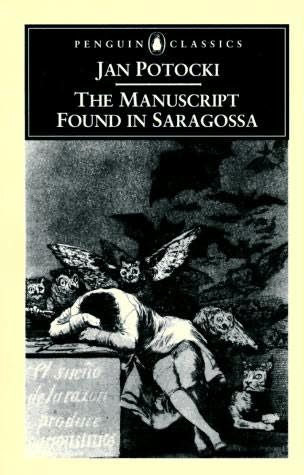
Jan Potocki:The Manuscript Found in Saragossa

When the chest was opened, a skeleton appeared, who came towards me in a menacing way. I drew my sword. The skeleton ripped off its left arm, and, using it as a weapon, launched a furious attack on me. I put up a good fight, but a second skeleton emerged from the chest, tore a rib off the the first skeleton and hit me over the head with it. I grabbed it by the throat but it clasped me in its fleshless arms and tried to throw me to the ground. I managed to get clear of it, but a third skeleton emerged from the trunk to join the other two. Then the other three appeared. Seeing no chance of coming away alive from so unequal a combat, I fell to my knees and begged the princess to spare me.
   The princess ordered the skeletons to return to the chest, then said, 'Romati, never forget as long as you live what you have seen here.'
   As she said this she grasped my arm. I felt it burn to the bone and I fainted.
This story is told by Giulio Romati to the gypsy chief Avadoro in a Spanish inn. Or rather it is being retold by Avadoro in the gypsy camp. to Alphonse van Worden, a young Belgian on his way to take up a commission in the Spanish army. Alphonse's story is part of a manuscript found by a French army officer after the siege of Saragossa in 1809, and supposedly written some decades earlier. The whole nest of stories constitutes the novel called the Manuscript Found in Saragossa by Jan Potocki. As a matter of fact, as Alphonse points out to Avadoro, the story of Giulio Romati, the ghostly princess and her retinue of skeletons comes from a collection of stories by a writer called Happel or Happelius. Saragossa is nothing if not intertextual, an anthology of weird, comic and sensational tales from across Europe. Like its modern British descendant, Robert Irwin's The Arabian Nightmare, it delights in the multiplicity of narrative, the way stories can hide inside other stories. And for Potocki as for Irwin dreams are stories too, the two used almost interchangeably to challenge our sense of reality.

Alphonse's journey to his regiment takes him across dangerous country. A bandit chief called Zoro has been terrorizing the area and is still at large, though his two brothers have been hanged and are now dangling grotesquely from a gibbet in a remote valley in the mountains. Alphonse's servants disappear, and he is forced to put up for the night at an abandoned inn. Lying in the dark he hears a clock strike midnight, the prelude to the first of his adventures. He is taken by a black maid to meet two beautiful Moorish women who are apparently staying at the inn in a luxurious room. They entertain him lavishly and tell him (of course) their story. They are Emina and Zubeida, daughters of the Great Sheikh of the Gomelez, who ruled this area in the days of the Moorish hegemony in Spain. Furthermore, there are related to Alphonse himself, cousins on his mother's side. Leaving aside the ties of kinship, he is infatuated with them, and promises on his honour as an officer never to reveal the details of their encounter. They part, he falls asleep - and wakes underneath the gibbet with the two brothers of Zoro dangling above him.

Are Emina and Zubeida what they seem, or are they demons, or the ghosts of the two hanged bandits? Alphonse meets a possessed man who has had a similar encounter; the mysterious women turn up again, and their flirtation becomes more serious. Encounters dissolve into dreams, and dreams keep leading him to the gibbet with its two corpses. Alphonse meets the gypsies, only to find that Avadoro's daughters bear an uncanny resemblance to Emina and Zubeida. Everyone has a story to tell and every story seems to have another one inside it.

Saragossa may sound like a work of postmodern metafiction, but it was written in the early nineteenth century. Potocki was a wealthy Polish aristocrat, a pioneer of Egyptology and ethnology, who established an independent press and reading room as well as flying over Warsaw in a hot-air balloon, and is said to have committed suicide with a silver bullet he forged himself out of his sugar bowl. The book is a compendium of Gothic themes, a guided tour of the state of supernatural fiction in the Romantic Age (gaining much of its effectiveness from the dry, understated style in which it relates extraordinary events), but it's also a document of the European Enlightenment, shrewdly interrogating the dreamy values of an old superstitious Europe to see what they amount to in the morning light. It's no coincidence that the basic story is set in Spain, with its ancient ideals of chivalry and honour. Spain is on the edge of Europe, and, as the story of the Great Sheikh of the Gomelez reminds us, has a complex religious and cultural heritage. The encounters and stories constantly pit Christian Europe against its Others, gypsies, Muslims and Jews (Ahasuerus, the Wandering Jew, is an important character). Bizarre as the stories are, they often begin unsensationally with an account of the narrator's upbringing; Potocki, in a thoroughly Enlightened way, is exploring the influence of education on an individual's life and character. At the centre of this exploration is Alphonse himself, whose father, an obsessive duellist, has brought him up to believe that honour and courage are the most important manly values. Saragossa is Alphonse's bildungsroman, his madly elaborate coming-of-age story, at the end of which he will realize that honour is not an infallible guide to behaviour and that, in a world where nothing is what it seems, reason is of more use.

I have now covered ten titles in White Threshold, starting with the historical epic The Man on a Donkey, and concluding with another equally grand epic, the first pre-twentieth-century, non-English-language title I have covered. I'm taking a break now, after which I hope to have some news about the future of the blog.

Friday, 10 February 2012

Muriel Spark: Robinson

In my posting on Riddley Walker, I mentioned my love of the kind of books that have maps at the front. Take a look at this one - not just a map but an allegorical map. It's obvious that the island represents a man, and both, like the novel, are called Robinson, a literary allusion that couldn't be more obvious. In 1958, it was unusual to flout the conventions of realism like this - Thomas Pynchon and John Barth were being greatly daring when they did something similar some years later, in V (1963) and Giles Goat-Boy (1966). Muriel Spark, a poet turned novelist, was in the process of working out for herself the genre we sometimes call, in a term invented by the critic Robert Scholes, fabulation. As practised by her, we might define this as about two parts allegory to three parts comedy, the comedy somehow both exuberant and deadpan. The map says it all, with its Treasure-Island fantasy ('Secret Tunnels'), precisely worked-out geography described in slightly poetic language ('Blue & Green Lake', 'Paths to Snow-White Beach'), and hilarious allegorical features ('The West Leg', 'The North Knee').

Three passengers survive from the plane that crashed on Robinson's eponymous island: January Marlow, a youngish widow and the novel's narrator, Tom Wells, an unpleasant salesman and charlatan specializing in lucky charms, and Jimmie Waterford, a Dutchman despite his name, who turns out to be a relative of Robinson's. There is one other character, the boy Miguel who is the son of one of the pomegranate planters who worked on the island before Robinson purchased it, and now cared for by Robinson. At first life is idyllic. There is ample food and nothing much to do until the pomegranate boat arrives on its scheduled visit in August, apart from milking the goat, listening to Robinson's Rossini records, and discussing relationships and theology. Robinson and January are both Catholics, the former more or less lapsed, the latter, like Spark herself, a recent convert. Robinson has retreated to the island because of his disillusionment with aspects of his religion, and the moral implications of retreat from what one finds unacceptable form the novel's theme. 'No man is an island,' Jimmie reminds him, but Robinson is doing his best to become one. Like January, whose name he initially mistakes for the month and place of her birth, he is a category error in human form.

Two-thirds of the way through this short book, Robinson disappears, and the plot shifts abruptly into a not very mysterious adventure mystery. It is always more of a romp, if any novel so intellectually sophisticated and elegantly written (Spark, at her best, is one of the great prose stylists) can be described in such terms. As well as the secret passages, there is blood, a volcano, and a lot of tension and intrigue between the one woman and two men, each of whom might be responsible for Robinson's death. To complicate matters, January is attracted to the morally ambiguous Jimmie - whose broken English also contributes to the comic tone:
   I dressed quickly and went in search of Jimmie. He was drinking brandy in Robinson's study. When he saw me he said:
   'Alas, I am abased to the servile floor.'
   I shivered, for in my haste I had not dried myself properly. I said, 'I'd like a drink.'
   He poured some brandy for me. 'I lose my nerves.'
Robinson was published four years later than that other desert-island allegory Lord of the Flies. One could read something into that, perhaps: an island suddenly shorn of its global empire returning to and revising the island fantasies that had sustained the spirit of imperial adventure from the start (The Tempest, Robinson Crusoe, Treasure Island). Another island novel, Joseph Conrad's Victory (1915), in which Axel Heyst's attempt to shut himself off from the wickedness of the world is rudely interrupted by the arrival of three strangers, must surely have been an influence.

Muriel Spark is the most established writer I have covered in White Threshold. By the end of her career she was Dame Muriel, author of The Prime of Miss Jean Brodie, which became an Oscar-winning film, rich and internationally famous. When she wrote Robinson, her second novel, she was none of these things. And I believe it's valid to stake a claim for cult status that applies to only part of a writer's work. Spark's five early novels, from The Comforters (1957) to The Bachelors (1960), together with the stories collected in The Go-Away Bird and Other Stories (1958) began an extraordinary outpouring of dark, funny, risk-taking fiction. Once this surge had reached its climax with the success of Brodie (1961) and The Girls of Slender Means (1963), she never again returned to the same level of sustained creativity, though there are isolated successes like A Far Cry from Kensington (1988). The pre-Brodie novels have received comparatively little attention, and Robinson may well be the least known of them all. Hardly surprising in some ways: its nuanced metaphysical debate, adventure-story trappings, and high comedy played with a straight face are, even by Spark's standards, distinctly unusual.

Nine titles done now, and for the tenth I have reserved something special. My first pre-twentieth-century text is also the first not to have been written in English: a pan-European metafictional epic.

Wednesday, 1 February 2012

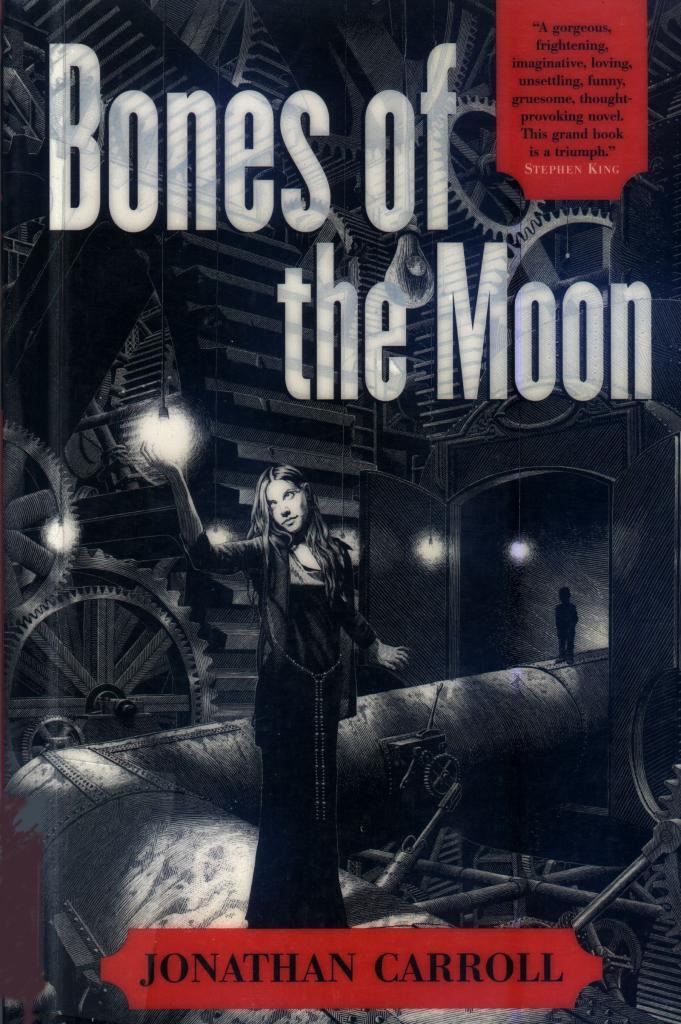
Jonathan Carroll: Bones of the Moon

Bones of the MoonLike most writers, I've woken up many times in the grip of a dream that seems like perfect material for a novel or a poem. Maybe you get as far as jotting it down before going back to sleep. When you wake up again, there's nothing there that makes sense. Dreams are fascinating to live through, but nonsense in daylight. Or, worse, they make too much sense - it's embarrassingly obvious what waking thoughts and experiences got translated into them. Either way they don't generally make good literature. And yet the urge to use them remains. Dreams are narratives, after all, and their very strangeness gives them the element of surprise we value in fiction. For writers who are fascinated by their own art (and what writer isn't?) they make a great metaphor for writing itself. They are used as a conventional framing device in,for example, Piers Plowman, The Divine Comedy, Alice. When we read them in this form, we're well aware of the conventions; the dream is not a real dream, and only retains those dreamlike characteristics that fit the writer's purpose.

In The Arabian Nightmare, Robert Irwin concentrates on two characteristics of dreams, the difficulty the sleeper sometimes has in telling sleep from waking, and the nesting of dreams within dreams. There is also a dreamlike strangeness due to the magical element that appears from time to time - but because of the blurring of sleep and waking, we never know if it's real or dream magic. Irwin's dreams are conventional - we are well aware that they are just another mode of storytelling. But there is one novel I know where the dreams are both an effective part of the narrative, and genuinely dreamlike.

Cullen James is a happily married woman living in New York with her husband and baby daughter. But there are a few shadows in her life. In the apartment downstairs, as we learn in the opening sentence of Bones of the Moon, a boy has gone crazy and killed his mother and sister with an axe. Before her marriage, Cullen herself had a series of unhappy relationships, culminating in an abortion about which she still has feelings of guilt. A charismatic but frightening film director is making insistent passes at her. And Cullen is suffering from her own version of the Arabian Nightmare, a series of intensely vivid dreams which connect together to form a continuous narrative:
How strange it was to eat glass and light. All of the food on the table was laid out beautifully and precisely. The spread would have looked delicious if everything wasn't transparent; splashing the light from the icy chandelier hung high and huge over the crystalline dining-table.
     Pepsi picked up his clear hot-dog wrapped in its clear bun and took a big bite. His walking stick leaned against the chair and was the only patch of colour around. Exposed to the sun for days on our walk here, the sticks had burned or ripened... changed from their original grey-brown to a deep, vivid purple.
     Sizzling Thumb had mine over his lap and kept petting it like a cat. 'Your tapes arrived without chicken.'
The dreams take the form of a quest through a magical land called Rondua. Cullen's companions are a number of talking animals, notably a hat-wearing dog called Mr Tracy, and a small boy, Pepsi, who is her son in the dreamworld (and, as we soon realize, a projection of her guilt about the abortion). They are searching for five magic tokens called the Bones of the Moon. And for all their surreal quality the dreams have a consistent structure: as they travel through the different regions of Rondua and collect the bones, the dream story moves towards its climax, a confrontation with the villainous Jack Chili. Meanwhile, Cullen's waking life is becoming more disturbed. The 'axe-boy', now in prison, has begun a worryingly obsessive correspondence with her. She seems to be developing supernatural powers; and the film director, Weber Gregston, starts having the same dreams.

Bones of the Moon is a brilliantly constructed fantasy thriller, though it teeters on the edge of sentimentality at times. But what really sets it apart is the portrayal of the dreams. Stephen King, an admirer of the book, has written: 'When has any novelist last caught so perfectly the weird but matter-of-fact experience of dreaming?' Never,as far as I know. These are the most dreamlike dreams I have ever seen in fiction, as absurd as they are compelling.

It's a nice piece of synchronicity that the author shares his surname with the author of the Alice books (though Lewis Carroll,of course,is a pen-name, while Jonathan is a Carroll by birth). He has written some fifteen novels, and all of those I've read show the same dazzling originality and imagination that characterize Bones of the Moon. Neil Gaiman, as well as King, is a fan. Carroll's first two novels, by the way, are published in the Fantasy Masterworks series, which I've mentioned before: I intend to blog about one of them at a later date.

Next time I'll be writing about an early, lesser-known novel by a major British post-war novelist.

Monday, 30 January 2012

Patrick Hamilton: Hangover Square

Hangover Square
Depersonalization is a psychological symptom in which the sufferer's sense of self is affected. The world suddenly feels remote and unreal. According to Wikipedia, it is the third most common psychological symptom, after anxiety and feelings of depression; it can be an indication of many underlying conditions, or induced by drugs, sleeplessness, shock, or even voluntarily, for example by meditation. If involuntary, it can be an unpleasant, alarming experience: I have suffered from it myself. So, undoubtedly, had Patrick Hamilton, who in his novel Hangover Square, gives a series of brilliant descriptions of it:
Like a camera. but instead of an exposure having been made the opposite had happened - an inclosure - a shutting down, a locking in. A moment before his head, his brain, were out in the world, seeing, hearing, sensing objects directly; now they were enclosed behind glass (like Crown jewels, like Victorian wax fruit), behind a film - the film of the camera, perhaps, to continue the photographic analogy - a film behind which all things and people moved eerily, without colour, vivacity or meaning, grimly, puppet-like, without motive or conscious volition of their own...
George Harvey Bone is a big, clumsy, unprepossessing man, living on a small inheritance in Earl's Court. His life revolves around two obsessions, the unpleasant Netta, whom he loves and despises at the same time, and the drink which is his only consolation for her rejection of him, as well as the main interest the two have in common. Netta is at the centre of a small group of hard-drinking, idle friends who exploit Bone for his comparative prosperity while mocking him to his face. It is just after the Munich agreement; Netta and the friends are supporters of Chamberlain, admirers of Hitler and Mussolini, another reason Bone has for hating them. But they continue their round of the London pubs, with a couple of trips to Brighton thrown in, endlessly engaged in the kind of mean-minded drunken smalltalk which is Hamilton's great contribution to fictional dialogue. From time to time Netta has a fling with someone, never with Bone. And from time to time also, he has what he calls one of his dead moods, his attacks of depersonalization. At such moments, he feels an overwhelming compulsion to kill Netta, a certainty that he will in fact eventually kill her. Then the mood passes and he cannot remember anything about it.

Hangover Square is the darkest of Hamilton's novels. Unlike his other masterpieces Twenty Thousand Streets Under the Sky and The Slaves of Solitude, both of which I hope to blog about in the future, it has very little humour. But, for me, it's his greatest achievement, an unblinking examination of the alcoholic bohemian lifestyle he knew so well, and which eventually killed him. One reason for that is the use of depersonalization: has any other writer described this symptom so well? And yet I strongly suspect it's a common experience of writers, of creative people generally. To write really effectively, you have to be able to drain the emotion from a scene, to look at it as if you weren't really feeling it. That way it becomes strange and new. The term used in literary criticism is defamiliarization - but that's only the literary manifestation of depersonalization. Hamilton gives us a defamiliarized Earl's Court through the eyes of a depersonalized George Harvey Bone. He takes the emotion out so that it will be all the more effective when it rushes back in again:
It almost knocked him down. It made him reel. It was as though he had been hit by something. And yet he knew what it was. It was only his head, cracking back. And with the crack everything came flooding, rushing, roaring back - noise, colour, light, the fury of the real, everyday world.
Hamilton was a successful writer in his lifetime; his plays Gaslight and Rope were both made into films, and made him a wealthy man. But after his death, in 1962 at the age of 58, his reputation went into eclipse. Since then there have been sporadic attempts to revive it, and the current one seems, finally, to have taken off. Twenty Thousand Streets Under the Sky was dramatized on BBC Television a few years ago, and his major works are all in print, including the Gorse trilogy, which I haven't read, and which is less highly regarded than the other novels I've mentioned. I hope he is now back for good where he belongs, among the major British novelists of his era.

Next time, a surreal story about dreaming by a unique US fantasy novelist.

Friday, 27 January 2012

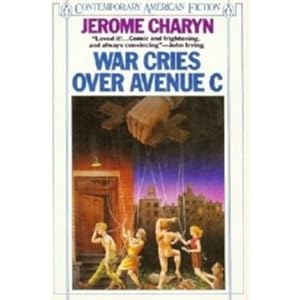
Jerome Charyn: War Cries Over Avenue C


Sometimes I think I started this blog for Jerome Charyn. Or at any rate that he is the author who most perfectly sums up what the blog is about. I still remember the first book of his I came across - it was in one of those bargain second-hand boxes, three for 50p. I had found two I wanted and was looking for a third, and there was Marilyn the Wild. I picked it because it was short, in good condition, and was published by Bloomsbury, who had just published my novel WHOM. I loved it. My editor at Bloomsbury was a fan, too - every time he moved to a new publisher, he signed Charyn up; but, he added, he just doesn't sell.

Marilyn the Wild is part of a series Charyn has written about a New York Jewish cop called Isaac Sidel. I'll write about these in a later posting, but for now I'm going to consider one of his stand-alone novels. War Cries Over Avenue C is set in New York's Alphabet City, an area which is introduced to us in a spoof prologue supposedly written by 'Doris Quinn, Your Manhattan Spy':
Cars move slower on Avenue A. You could die whistling and might not meet a Checker cab. You've entered Indian country without even knowing it.
The combination of urban realism and disconcerting playfulness is characteristic. He knows the world he's writing about so well that it's hard tell when he's exaggerating, or just plain making things up. Sarah Fishman, Saigon Sarah from her time as a nurse in Vietnam, when she wore two .45s to defend her Viet Cong patients from their interrogators, now lives in a fortified Talmud school on Avenue C with her childhood sweetheart, Howie Biedersbill, a Henry-James-loving assassin who still has bits of shrapnel in his scalp from his own Vietnam years. They manage to survive in a world of CIA agents, Bolivian drug-runners and KGB men who use Mont Blanc fountain pens as a weapon. Howie's arch-enemy Capablanca holds him upside down out of a window to force him to admit that Gabriel Garcia Marquez (El Nobel) is a greater writer than Henry James. The Vietnam that provides the backstory to this saga of a crazed New York is just as surreal: Howie has lived among the Montagnards of the Central Highlands in a tribe of sorcerers and magicians:
They took their hammocks, their chicken claws, their poison tubs, tobacco, salt pots, arrows, antidotes, jewels and silver pipes, opium balls they'd fashioned from their last Cambodian brick and ate like cotton candy, a mound of plastique that Judith kept in a rag, jungle knives, French cigarettes that the matriarchs liked to smoke when their mouths grew sore from silver pipes, cutlery to prepare food for the devils, children's toys, French panties from Saigon for the teenage girls, a medicine chest of roots, barks and herbs, white cotton leggings that the women sometimes wore, a clutch of high-heeled shoes, the spirit table and the spirit chair.
[Judith, by the way, is a man who uses a woman's name for magical reasons.]

A touch of El Nobel in that passage, perhaps? Such a long sentence is rare in Charyn's work - he usually writes in the tersest of hard-boiled prose. But even in the most thriller-like passages of War Cries, there is still the sense, as there is in the work of that other New York Jew William Tenn, of the magic that automatically occurs when tribes who are totally alien to each other are suddenly thrust into proximity. Tenn's Venusians are no stranger than Charyn's Montagnards.

Charyn spent many years teaching in Paris, and still has a home there. Honoured with the rank of Commandeur des Arts et des Lettres, he is not the first American writer to be more appreciated in France than his native land. (There is another example on my list of subjects for future blog entries.) The author of thirty novels, he is still writing at 74, and his most recent publication, The Secret Life of Emily Dickinson, sounds like one of his most daring projects. Other books chronicle his interests in film, table tennis, baseball, the Wild West, and, of course, the history of New York. And, as with William Tenn, Robert Irwin, H.F.M Prescott and so many other authors I intend to cover on White Threshold, hardly anyone I know seems to have heard of him.

Next time, a major British mid-20th-century novelist who seems at long last to be on the verge of achieving the reputation he deserves.

Monday, 23 January 2012

Shirley Jackson: We Have Always Lived in the Castle

We Have Always Lived in the Castle
Merricat, said Connie, would you like a cup of tea?
Oh no,said Merricat, you'll poison me.
Merricat, said Connie, would you like to go to sleep?
Down in the boneyard ten feet deep!
In Riddley Walker, Russell Hoban makes powerful use of children's rhymes to create atmosphere. In We Have Always Lived in the Castle, there's only one rhyme, but it re-echoes throughout, epitomizing the novel's darkly naive tone. Merricat is Mary Katherine Blackwood, the eighteen-year-old narrator, and Connie is her beloved elder sister Constance. The Castle is the grand house they live in with their disabled Uncle Julian; because we see them through Merricat's eyes, and she is clearly quite disturbed, we never really see the Castle and its adjacent village as part of modern America - they are always on the verge of becoming a fantasy realm. Six years ago the rest of the Blackwood family were murdered. Constance was accused of the crime but acquitted for lack of evidence. The villagers, whose children taunt Merricat with the rhyme above, still hate and fear both of them. This is the situation when a cousin, Charles, comes to visit, upsetting the balance of this strange household.

The Gothic has been an important strain in American literature since well before its two great nineteenth-century exponents Poe and Hawthorne. But those two writers stand for the two main currents in American Gothic, the Southern and New England varieties. After all, the Gothic depends on a strong sense of the past, and the South and New England are the oldest parts of the United States, the areas where the image of a castle or a grand old house haunted by ancestral ghosts seems least incongruous. Also both have strong religious traditions and the sense of evil that goes with them. And Gothic without a sense of evil is just a kind of literary fancy dress.

Shirley Jackson was born in California, but lived in Vermont. In her six novels you can see her working her way into the New England Gothic tradition, creating more and more convincingly a world that is both magical and contemporary. And she has the sharpest eye for evil of any writer I can think of. For Jackson, it doesn't come as buckets of blood and torture porn and it never comes unmixed; there are no monsters in her work. There is evil in the Castle, but there is also charm, humour and a particularly touching portrayal of sisterly love. And there is evil outside the Castle, too, in the villagers' hatred - understandable in its origin but always ready to go out of control.

Much of the fascination of the book is in Merricat's voice, childlike in spite of her age. Jackson is superb on children, and wrote a couple of books about her own experiences as a mother: one of them is called life Among the Savages, and as this title implies, her theme, for all the love and humour with which she writes, is that they are as prone to evil as the rest of us - indeed, it's more obvious in children because they haven't learned to hide it. The children persecute Merricat with their rhymes and her own vindictiveness towards Charles is inseparable from her childish preoccupation with the comfortable rituals of her life.

Castle is a short novel, almost a novella, and utterly gripping. The major twist in the plot is one that almost every reader will have seen coming long before, but there is another, almost incidental, surprise which is quite devastating. It's the work of a brilliant writer at the height of her powers: sadly,she died soon after completing it, at the age of 49, worn out by psychological problems and abuse of prescription drugs. Her vision cannot have been a comfortable one to live with, and it says a lot for her both as a person and an artist that her work, though always disturbing, is never depressing. (Much of it is extremely funny.) She is better known in the US than the UK - I'd never heard of her till a reader recommended her on one of the Guardian Books blogs. Even there, her reputation seems to rest mostly on one short story, 'The Lottery', and on her novel The Haunting of Hill House, which was made into a successful film. There have been rumours of a forthcoming film of Castle for a long time now, but I haven't heard of a release date yet. I'll return to Jackson in the future, as I will to several of the other authors I cover in this blog.

Next time, a quirky thriller by an imaginative and immensely prolific US novelist who excels across several genres.

Wednesday, 18 January 2012

Robert Irwin: The Arabian Nightmare

The Encyclopedia of FantasyOne of my most fruitful sources of cult fiction is The Encyclopedia of Fantasy, edited by John Clute and John Grant. It's much more than a reference work; you can spend hours browsing among its articled under such imaginative headings as Fimbulwinter (the Norse myth of an unending winter has many modern offshoots, including the opening scenes of The Lion the Witch and the Wardrobe), or Into the Woods (Stephen Sondheim's musical is one example among many of the trope of a forest where normal human order is replaced by something more chaotic). I imagine I found The Arabian Nightmare under Dreams, since this is the novel's major theme.

Robert Irwin is a distinguished scholar of medieval Arabic literature, whose works include The Arabian Nights: A Companion. The Arabian Nights is what The Encyclopedia of Fantasy calls a Taproot Text, a classic work that continues to influence later generations of writers. In particular, postmodern novelists like John Barth have found inspiration in the way some of the stories are nested inside each other, many levels deep. The Arabian Nightmare is Irwin's treatment of this idea.

A group of pilgrims enters medieval Cairo, and puts up at a caravanserai, where one of them, a young Englishman called Balian, falls asleep and has a disturbing dream. When he wakes, blood is pouring from his mouth and nose, and the other pilgrims are crowding round in concern. He seems to have an illness - well, at least, they keep reassuring him, it is not the Arabian Nightmare. In the Arabian Nightmare, the dreamer experiences infinite suffering at night, and then wakes up in the morning unable to remember any of it. It is the ultimate in pointless suffering, so much so that some believe the Messiah himself will be one who has been purified by this disease.

The Cairo Balian encounters is a city of squalor and magic. Huge mountains of refuse outside the city walls cause dust and foul air to blow down the hot streets. There are great encampments of beggars sleeping in the open air, dwarfs, mountebanks and storytellers entertaining the citizens. There is a tightrope-walker who performs in his sleep (funambulist and somnambulist at the same time). The streets are haunted by Fatima the Deathly, an irresistibly attractive woman who lures men to their doom, and by rumours of the Laughing Dervishes, whose outrageous hilarity can disrupt the most solemn rituals. Everyone seems to be involved in a conspiracy, either for the Sultan or against him.

But how much of this is real, and how much a dream? Balian keeps waking up in his own blood, unsure at what point he fell asleep. He is having an affair with the seductive Zuleyka, who teaches him the art of giving sexual pleasure to a woman (as a medieval Western Christian, Balian has trouble at first understanding why he should want to). He undergoes treatment from the Father of Cats, a physician who specializes in the diseases of sleep, and is chased through the labyrinthine streets by a secret society of leper knights. Perhaps he has the Arabian Nightmare after all.

This appears to be Balian's story, but there are whole chapters where he doesn't feature. Sometimes we read instead about the Father of Cats, the Dawadar or Bearer of the Royal Inkwell, the English graverobber Michael Vane. There is a narrator, the Coptic storyteller Dirty Yoll, who seems to be controlling things - but is he a character in Balian's dreams, or is Balian a character in Yoll's story? At a certain point it becomes impossible to tell. And just when we are feeling totally lost, Yoll breaks off the main narrative to tell us another set of stories altogether, an Arabian Nights in miniature. There are four chapters of this Interlude, as Yoll calls it:
An Interlude - The Tale of the Talking Ape
The Interlude Concluded
The Interlude Concluded Continued
The Conclusion of the Continuation of the Interlude's Conclusion
It's my favourite part of the book. Stories spawn stories at a startling rate, each one echoing and parodying the others. There is a boy who was brought up by wolves, another who was brought up by apes, by bears, by leopards. There is a voyage to the end of the world. There are murders, enchantments, riddles, seductions. And there is just a page or so on the theme of three wishes in which Irwin plays every possible variation you can imagine on this ancient idea.

The Arabian Nightmare is not a novel for those who can't stand conspicuous cleverness. You can tell it's by an academic, and also, perhaps, that it's a first novel. It begins, anachronistically, with a quote from Proust and there are numerous other literary references scattered throughout. But to me its ingenuity and creativity are irresistible, and it offers a beguiling picture of the medieval Arab culture Irwin knows so well - though it's probably best to confirm some of the details from his more scholarly writings. He is now a full-time writer and has written several other well-received novels. The Arabian Nightmare's reputation has grown slowly; it is still in print some thirty years after its first publication, and has established itself as a cult classic.

Next time I'll be writing about the blackest of black comedies by an arch-exponent of the American Gothic.

Wednesday, 4 January 2012

William Tenn: Immodest Proposals / Here Comes Civilization

A smalltime businessman is sitting in his poky office when a man walks in without knocking and asks, "Would you be interested in buying a twenty for a five?" The newcomer is dirty and disreputable looking; the businessman tells him there are no beggars allowed in the building, and tries to throw him out. The newcomer wants to know what's wrong with his offer, but the businessman is unrelenting, so he retreats, leaving his card: he is Mr Ogo Eksar, operating out of a hotel in Times Square. The businessman, Bernie, can't get the incident out of his head. Obviously there's a catch, because no one in his right mind would offer to pay twenty dollars for a five-dollar bill. But Bernie's a bit of a hustler himself - he'd like to know what the catch is, and it can only cost him five dollars, at the worst, to find out. So he goes round to the hotel in Times Square, and they do the deal - the twenty and the five are exchanged and Eksar even insists on a receipt.

What happens now? Maybe Mr Eksar would be interested in another deal, say, buying a ten for a fifty, or a twenty for a hundred dollars?

Eksar is contemptuous. What kind of a deal is that?

Well, Bernie says, isn't there anything else you want to buy?

The Golden Gate Bridge.

This is the opening of William Tenn's short story 'Bernie the Faust'. In the course of a couple of pages, the two find themselves negotiating over other geographical features, like the Sea of Azov (It's only forty-nine feet deep! "Where are you going to do better than three hundred and eighty dollars for a sea like that?"), not to mention fishing and buried treasure rights on the moon. Bernie is slightly uneasy about the fact that he doesn't actually own any of these things, but Eksar is happy to agree to purchase only whatever rights Bernie may have to them, just so long as he gets his receipt. Of course, there is a catch, and Eksar is not what he seems. There are several twists before the end, but I won't spoil them for you.

I was probably about eleven when I first read that story. I was reading a lot of SF at the time, and other stories that made a deep impression on me were Isaac Asimov's 'I'm in Marsport Without Hilda', Damon Knight's 'The Country of the Kind', and Bob Shaw's 'Light of Other Days'. I read them for their inventiveness, and William Tenn consistently seemed to be the writer with the best ideas. I got a book of his stories, Time in Advance, out of the library: all of them were brilliant. I was on my way to becoming a fan.

Then - a refrain that will recur many times in this blog - I couldn't find anything more. All my friends were reading Asimov, nobody had heard of Tenn. In due course, my interest in SF cooled anyway (it has revived in the last few years), and I began to think I had imagined him, until one day about ten years ago I found 'Bernie the Faust' on the web, and it was as good as I remembered - better in fact, because I now understood how cleverly Tenn was manipulating the conventions of Jewish humour to make them into SF. It turned out he had a website, from which I learned that his real name was Philip Klass, and that his complete fiction had been published by NESFA Press, in two volumes (whose brilliant covers are shown here), called Immodest Proposals and Here Comes Civilization.

One reason for Tenn's comparative obscurity is that he was a short fiction specialist. The Golden Age of Science Fiction was dominated by magazines, in particular Astounding Science Fiction and Galaxy. That meant a big market for shorter forms, not just the short story proper, but the novelette (defined by the Nebula Awards as having a length of between 7,500 and 17,499 words, and the novella (between 17,500 and 40,000 words). There was a good living to be made writing these shorter forms, and they could subsequently be republished in anthologies and collections. But as the magazine market diminished, so too did the interest in short fiction, and writers like Tenn became marginalized. There is some hope the internet will eventually reverse this process - too late for Phil Klass, who died in 2010 at the age of 89, though from what I've read of him he was not the kind of man to feel any bitterness about it.

Of all the classic SF themes - post-apocalypse, androids, space travel, time travel, etc - it is aliens that Tenn excels in. In 'The Sickness', an arrogant intellectual on an international expedition to Mars is unnerved when all his companions are transformed by a virus into disembodied super-intelligences, like the Martians themselves. In 'Firewater' the aliens who have colonized Earth are so different from us that the only humans who manage to communicate with them go mad - though enriched by their contact with technological knowledge that is a valuable resource for any normal humans who are willing to trade with them. And in 'Venus and the Seven Sexes', he gives us an elaborately worked-out Venusian creature that has adapted to its hilariously hostile environment by evolving into seven distinct forms, creating a life-cycle so complicated it just manages to avoid extinction:
There is only one thing that all the ravening life-forms of Venus would rather eat than each other, and that one thing is a Plookh.
There's a joyous extravagance in his exploration of the idea of alienness and the juxtaposition of incompatible values it implies: they may be bug-eyed monsters to us, but we, to use a term from one of his stories, are flat-eyed monsters to them. This relativism puts him in a great satirical tradition which, as the title Immodest Proposals suggests, he was well aware of. It's also, of course, a natural theme for a New York Jew, aware not only of a heritage of obscure and wonderful knowledge, but also of the daunting fact that many of the other groups around you would rather devour you than each other.

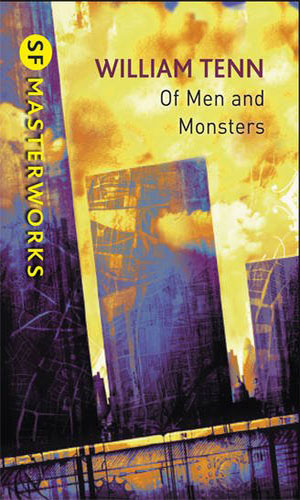
If you don't fancy buying the complete works, his only novel, Of Men and Monsters, is available in the superb SF Masterworks Series. (It is also included in Here Comes Civilization, and illustrated on the cover to that book, shown above):
Mankind consisted of 128 people.

The sheer population pressure of so vast a horde had long ago filled over a dozen burrows. Bands of the Male Society patrolled the outermost corridors with their full strength, twenty-three young adult males in the prime of courage and alertness. They were stationed there to take the first shock of any danger to Mankind, they and their band captains and the youthful initiates who served them.

Eric the Only was an initiate in this powerful force.
Giant aliens have invaded Earth and taken over all our resources. Nothing like a war can be said to have taken place: the aliens are too huge and advanced even to recognize us as intelligent. Human beings are reduced to living, mouselike, in burrows in the walls of alien houses. (Some editions of the novel carry the alternative title The Men in the Walls.) This is Tenn at his most Swiftian, ruthless in the accuracy of his satire. Like the mating cycle of the Venusian Plookh, the anthropology of his parasitic Mankind is worked out with a rigour that probably owes something to the influence of his scientist brother, Morton. It's a very funny, but sometimes dark, book, and makes a great introduction to Tenn's work.

It's about time I did an entry on a living author, so next time I will be blogging about the first novel of an eminent British scholar of Arabic literature, a fabulation set in medieval Cairo.

Sunday, 1 January 2012

Russell Hoban: Riddley Walker

Map from Riddley Walker I have always liked the kind of books that have maps at the front. They seem to promise, not just a story, but a whole world. In fact, the more documentation the better as far as I'm concerned - I'm also fond of those lists of characters you get in Tolstoy, and the family trees in epic novels like One Hundred Years of Solitude. Probably the novel that offers most in this department is The Lord of the Rings, with its fold-out maps, and no fewer than six appendices on things like languages, chronology and pronunciation.

Riddley Walker is a slim novel, unlike these other examples, but it keeps the promise made by the map at the front: you get a world as well as a story. It's the world of the eponymous hero, and it doesn't take much scrutiny to realize that it's actually a slightly altered map of Kent, a Kent of the future where some of the landscape and all of the placenames have changed: Cambry is Canterbury, Do It Over is Dover, Sam's Itch is Sandwich, Horny Boy is Herne Bay, and so on. Only the road names eerily remain the same, but you have to walk rather than drive on them, because this is Kent several hundred years after a nuclear apocalypse.

The post-apocalypse story is one of the oldest themes in science fiction, and the post nuclear variety is the most common of all: Walter M. Miller's A Canticle for Leibowitz, John Wyndham's The Chrysalids and several novels by Philip K.Dick, such as Do Androids Dream of Electric Sheep, Dr Bloodmoney and The Three Stigmata of Palmer Eldritch are classic examples; more recently, Cormac McCarthy's The Road has reminded non-SF buffs of the perennial power of the theme. Apocalypse in general appeals to our fantasies of a more primitive life that may offer greater freedom or excitement - it's closely related to other fantasies of simplification, like desert island stories or pastoral poetry. But the nuclear versions, being based an all-too-possible catastrophic scenario, tend to emphasize the loss and suffering involved rather than the liberation. Often (in Miller's novel, for example), finding out exactly what went wrong is important to the characters, as is trying to reconstruct imaginatively the world before the war. That means defamiliarization comes into play; we know what our world is like, but through the efforts of the characters we get to see it as it would look from a very different perspective, and perhaps value it more as a result.

Riddley Walker is typical in this respect. The characters spend a lot of their time digging up objects from before the apocalypse (One of them is a Punch puppet from a Punch and Judy show), and a lot more time telling stories and singing songs which contain cryptic references to the earlier civilization and what happened to it. The people from "back way back" had "boats in the air and picters in the wind", but they lost it all through their fatal obsession with the "1 Big 1", the nuclear bomb. They've developed an entire culture out of the ruins of ours.

What sets this apart from other treatments of the theme is the language. Hoban's masterstroke was to invent a future version of English. Here is the funeral for Riddley's father, killed while trying to excavate a giant machine from the industrial age:
We done the berning that nite on the bye bye hump. The moon were cloudit over and a hy wind blowin. I put the 1st torch to the stack then Straiter Empy for the crowd then Rockman Bessup for Widders Dump then Lorna Elswint for las. Arnge flames upping in the dark and liting all the faces roun. Catching that time of that nite stoppt on all them faces. You cud smell the berning sharp on the air mixt with the meat smel from the divvy roof. Dogs begun to howl it were coming and going on the wind. The fire blowing in the wind and the sparks whup off into the dark and gone. Dark and gone. Before the wording we sung Sarvering Gallack Seas:

     Pas the sarvering gallack seas and flaming nebyul eye
     Power us beyont the farthes reaches of the sky
     Thine the han what shapit the black
     Guyd us there and guyd us back
This gives some idea of the power of this new language. The description would be vivid even in standard English, but it's full of mistakes or misunderstandings that not only defamiliarize but create new metaphors: galaxies become seas, nebulae become an eye. In the continuation of the passage, the "wording", where the members of the community share their memories of the dead man, it becomes clear that they've misinterpreted the word "thine" in the song; everyone sits round and "thines" hands. The language of the book is full of little touches like this, some funny, some enriching. Reading it is a unique experience.

It could be argued that Riddley Walker is too well-known by now to be considered a cult book any longer. I thought of doing a posting on Kleinzeit, which is my second favourite of Hoban's books, but in the end felt that his masterpiece simply could not be avoided. Like The Man on a Donkey, it is one of the great novels of modern times: my account here doesn't give an impression of how moving it is (the ending is shattering), but readers who don't know it can find much more on the web. Hoban died on 13 December at the age of 86; despite the fame of his best-known novel, he was a cult author through and through, taking the most outrageous risks with his writing and getting away with them more often than might be thought possible.

Since my last posting I've discovered a very recent and excellent review of The Man on A Donkey by Rosemary Mitchell in the online journal Open Letters Monthly. Like me, Mitchell sees it as a great and neglected book; she also cites the similar view of my friend Diana Wallace in her study The Woman's Historical Novel: British Women Writers, 1900-2000. Maybe a groundswell of support for Prescott is beginning at last - I'd like to think so.

My next posting will be on the two-volume collected works of another recently deceased writer, a brilliant satirist from the Golden Age of SF.